The Virtual Reality and Digital Engineering (VRD) Platform
Development of interactive applications and simulations, from immersive virtual reality to PC, tablet and mobile platforms, to enable neuroscientists to explore the complex mechanisms of the human brain.
The creation of highly controlled and perfectly reproducible digital environments makes it possible to design experimental paradigms inaccessible in the physical world. The real-time integration of EEG and fMRI data provides a flexible digital infrastructure, tailored to the demands of innovative, cutting-edge, multimodal human neuroscience.
Mission
Led by Margaux Dubessy, the virtual reality and digital engineering (VRD) platform bridges the gap between advanced software engineering and human neuroscience. Far more than just a technological support, the platform assists research teams at Campus Biotech and other institutions in the design, development, and integration of interactive experimental scenarios and immersive 3D environments.
Its expertise is based on a constantly evolving library of proprietary software components and a modular hardware infrastructure. The standardization of these technological building blocks allows for the rapid adaptation of the same experience to different platforms, including virtual reality, computers, and mobile devices. This approach accelerates project development, facilitates live demonstrations, and guarantees researchers a robust, flexible, and scalable digital infrastructure to push the boundaries of cognitive neuroscience.
Services
Software development
The VR & Digital Engineering team offers tailor-made solutions to bring your ideas to life:
- Expertise in XR and Serious Games – Assistance in designing immersive and interactive experiences.
- Creation of 3D content and development of custom scenarios – From scratch or from your existing assets.
- Large library of software and technical resources – Ready-to-use tools, constantly expanding.
- Gamification – Make your applications more attractive, intuitive and engaging!
Discover below the videos of some of the projects completed!
You want to develop an application for PC (Windows, Mac, Linux), tablets, iPad, smartphones (Android, iOS) or XR ?
VR + MRI + Motion capture
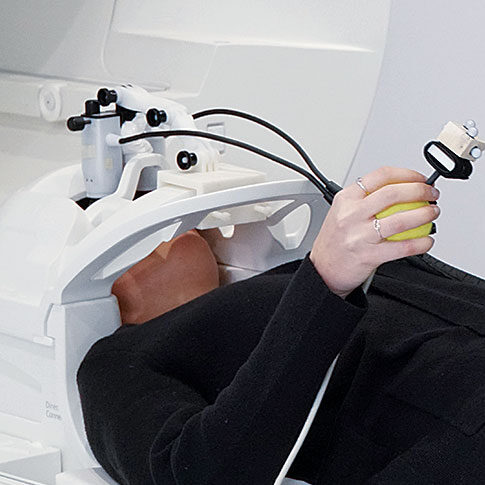
The platform offers an exceptional integrated system which combines:
-
3T MRI Scanner – Siemens
-
Stereoscopic glasses – NordicNeuroLab
-
Motion capture technology – Qualisys
This unique set allows for advanced research by seamlessly combining high-resolution imaging, Immersive visualization et precise tracking of movement.
An example of an application is a custom-developed virtual environment, allowing a seamless transition from the real world to VRThe virtual space is an exact replica of the real environment, which allows the MRI scanner to visually disappear — thus contributing to reduce claustrophobia and improve participant comfort during the experiments.
Custom and off-site VR solutions
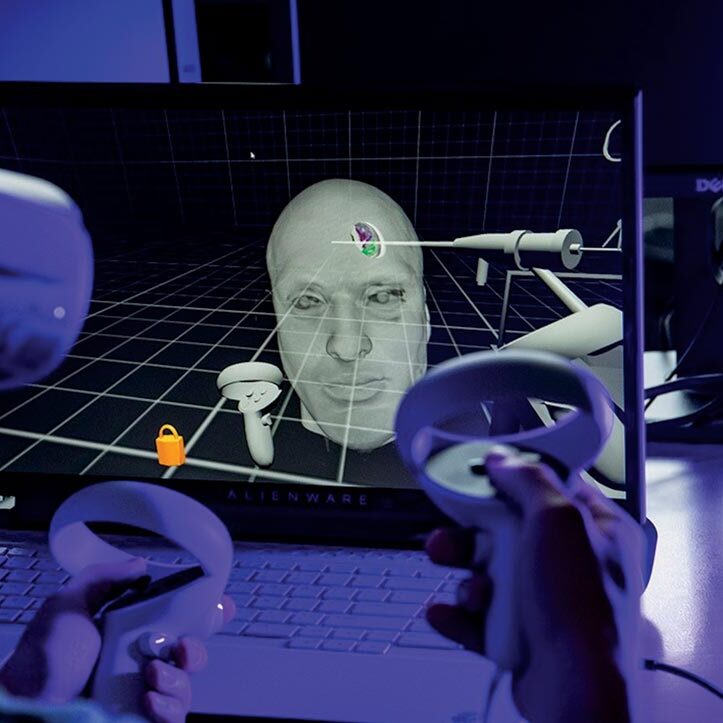
To facilitate research outside the laboratory, the platform offers a range of high-performance portable equipment available for rent. You can use these tools to conduct experiments and collect data directly at external sites, such as schools, hospitals, or natural environments.
Our fleet of mobile equipment includes:
- Standalone extended reality headsets (HMDs): Meta Quest 3, Quest 3S and Quest Pro for high-quality wireless immersion.
- Advanced integrated tracking systems: Pico Neo 3 Eye and Pico 4 (eye tracking), as well as HTC Vive Focus Vision, which supports integrated eye and face tracking for collecting complex social and emotional data in the field.
- High-performance computing: VR-ready laptops configured to support demanding simulations and off-site data recording.
Integrated search solutions: For multimodal studies, these virtual reality systems can be fully integrated with the equipment of the MEEG platform. EEG and various biophysiological systems are also available for rent, enabling synchronized neurophysiological and behavioral recordings off-campus.
Motion capture
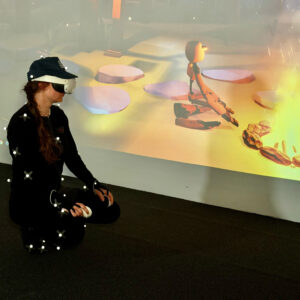
The motion capture system consists of 12 OptiTrack Prime 13 cameras accompanied by the dedicated software Motive.
You can rent the hall 70m² to perform tests or conduct experiments with:
- motion capture system,
- stereoscopic wall (3D vision with passive glasses)
- VR/AR headsets (HMD) — see the available list.
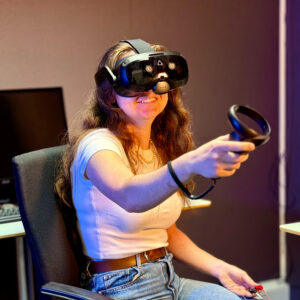
VR Room
You can rent a room dedicated to virtual reality experiences within the Campus Biotech building.
It is equipped with a VR-Ready PC and virtual reality headset (VRD) — see the available list.
For multimodal studies, the room can be combined with other equipment available on the platforms, such as physiological data recording systems, etc.EEG, etc.
New Products
- Immersive MRI simulation : development of a virtual reality application that faithfully reproduces a real MRI environment. Users can interact with an avatar and control its body in real time to simulate a complete MRI scan experience.
- Cross-platform deployment : design of pipelines enabling the distribution of applications on the main ecosystems, including Steam, the Google Play Store (Android) and the App Store (iOS).
- Advanced integration of eye tracking and facial expressions : optimization of the integration of eye-tracking and facial expression analysis solutions directly within the platform's applications.
PROSPECTS AND ACHIEVEMENTS
- Virtual reality integration compatible with 7T MRI : development and integration of an advanced virtual reality system directly within a 7 Tesla MRI scanner, enabling the implementation of immersive visual simulations during the examination.
- AI-powered interactive avatars : integration of advanced artificial intelligence technologies into the platform's applications to generate realistic avatars. These agents incorporate generative speech synthesis, dynamic facial expressions, and natural eye movements, enhancing the quality of social interactions in virtual environments.
The Virtual Reality and Digital Engineering platform makes it possible to create experiences closer to everyday reality, while offering precise measurements of brain functions, a crucial advance for our understanding of the brain and behavior.
Prof. Daphne Bavelier
UNIGEExamples of video projects

FCBG VR: Centre qap - Savane Game
01:54

FCBG VR: Motion Capture Demo
01:12
FCBG VR: UNIGE - TikTik
00:39

FCBG VR: Anouk foundation project
00:55

FCBG VR: UNIFR - ABCCD syntax game
01:03

FCBG VR: 3D environments demo
00:48

FCBG VR: UNIGE - Anomia Word (re)learning
01:14

EcoRescue
01:52

Multi device VR/EEG/Mocap application
01:41

Stressfull task for adolescents - UNIGE
02:01

UNIGE - Robbin Goblins
01:22

Be An Airplane Pilot
03:33

Neurotrainer
01:30
VRD – News, events and conferences
Follow the latest advances in brain imaging on our Virtual Reality and Digital Engineering (VRD) Platform. Articles, studies, and innovations showcase the clinical and technological applications emerging from Campus Biotech Geneva.
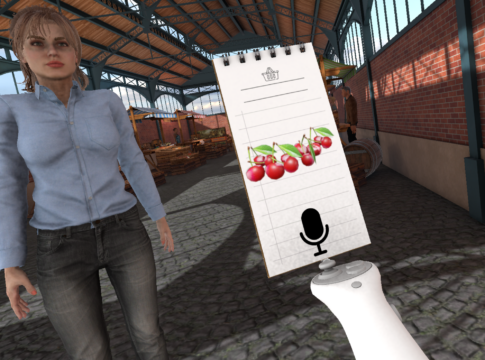
Virtual reality to combat language disorders
Linguistic assessment in communicative contexts: Some patients report a discrepancy between their performance in medical settings and in their daily lives. The...
Relieving anxiety in teenagers
Video games to relieve anxiety: Video games dedicated to mental health have become a preferred tool for supporting teenagers, in...
VRD – Events and Conferences
Follow the latest advances in brain imaging on our Virtual Reality and Digital Engineering (VRD) Platform. Articles, studies, and innovations showcase the clinical and technological applications emerging from Campus Biotech Geneva.
Highlights
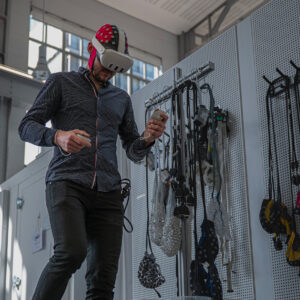
- Developing seamless XR experiences across all fixed and mobile platforms, combining virtual environments with advanced motion capture technologies and biometric sensors.
- Synchronization of digital environments with advanced brain imaging techniques (fMRI, EEG, MEG) in order to conduct real-time multimodal neuroscientific studies.
- Maintaining close and iterative co-design cycles with scientists, in order to quickly translate complex experimental needs into functional code.
- Implementation of an ecosystem of reusable software modules to significantly accelerate development times.
- Construction of rapid interfaces for the integration of custom hardware, ranging from microcontrollers and physical triggers to specific telemetry streams.
Reviews

Key figures
Expansion of the application catalog to
0 projects delivered
0 publications
in 2024 (scientific journals)
0 projects developed
during the year, including:
-
Woundcare is an educational mobile application developed by the VRD platform using Unity in collaboration with Professor Swann Pichon (HES) and the company Imito, thanks to funding from Innosuisse. This serious game, tested at the Geneva University Hospitals (HUG), allows healthcare professionals to strengthen their skills in wound assessment and management through interactive activities and progressive challenges. By collecting points, players contribute to the construction of a virtual wound care clinic.
-
Drawing and Detective is a series of games developed for the virtual reality room at the QAP Centre in Carouge, a rehabilitation center for children with disabilities. Used by physiotherapists, these interactive games, projected onto a 2x3m wall via a motion capture system, motivate children to be active while having fun. "Drawing" allows for free painting and creation, while "Detective" challenges children to find hidden objects in a street, with adjustable difficulty levels.
Our Team
Margaux Dubessy
Head of the Virtual Reality and Digital Engineering Platform... learn more
Margaux Dubessy joined FCBG in 2017 as a virtual reality engineer before moving into her current role as platform manager. Bridging cutting-edge engineering and advanced human neuroscience, she leads a development team specializing in the design of complex virtual environments for research. Her work focuses primarily on the multimodal integration of virtual reality with neural and physiological systems—including MRI-compatible setups and motion capture for neurological rehabilitation—ensuring that the solutions are both technically robust and scientifically validated.
Nathan Attia
VR and Systems Integration Engineer... learn more
Nathan Attia joined FCBG in 2021. A graduate of the Arts et Métiers engineering school and trained at the Laval Virtual Centre, he designs immersive environments for complex behavioral studies. He excels at using gamification to transform rigorous experimental protocols into interactive and highly engaging experiences that boost participant motivation and improve data quality, while meticulously adhering to medical and scientific objectives. Furthermore, Nathan manages the integration of advanced tracking technologies—including eye-tracking, facial expression analysis, and wearable devices—ensuring their seamless synchronization with EEG and biophysiological sensors for high-precision, multimodal studies, both on-site and in the field.
Mael Lacour
Senior VR/AR Engineer... learn more
Maël Lacour has been a Senior XR Engineer at FCBG since 2020 and is a Unity Certified Expert Programmer. He designs and develops virtual and augmented reality applications specifically for neuroscience and cognitive science research, with specialized integrations for research hardware, including EEG and fMRI systems. He develops and deploys these applications across multiple platforms—Windows, Linux, Android, and iOS—adapting them to the specific constraints of scientific research environments. He also develops the backend infrastructure that connects the applications to larger research systems, enabling real-time data flow and synchronization, and creates custom dashboards that allow research teams to monitor, record, and analyze participants' behavioral data throughout and after experimental sessions.
Arthur Trivier
VR Engineer... learn more
Arthur Trivier joined FCBG to bridge the gap between creative design and fundamental engineering, developing 3D applications for brain research. A physicist by training, Arthur holds a degree in applied physics and instrumental techniques for metrology, which sparked his interest in virtual reality headsets. He then earned a master's degree in physics and sensory engineering, focusing on anthropological sciences and product design, with a specialization in virtual reality. He followed this with a second master's degree in interactive 3D technologies, joining the community that uses these technologies to study human behavior and the mind. Drawing on this dual expertise, he discovered a passion for real-time 3D rendering and immersive technologies. Excelling in both the creation of original 3D scenarios and the improvement of existing ones to meet research needs, he ensures that visually captivating and realistic environments work with the high performance and smooth frame rates required for rigorous behavioral studies.
Platform Advisory Committee
Address
Fondation Campus Biotech Geneva
Chemin des Mines 9, 1202 Geneva
Hours
Monday to Friday, 9:00 – 18:30