

Because of the depth of the hippocampal-entorhinal complex (HC-EC) in the brain, understanding of its role in spatial navigation via neuromodulation was limited in humans. Here, we aimed to better elucidate this relationship in healthy volunteers, using transcranial temporal interference electric stimulation (tTIS), a noninvasive technique allowing to selectively neuromodulate deep brain structures. We applied tTIS to the right HC-EC in either continuous or intermittent theta-burst stimulation patterns (cTBS or iTBS), compared to a control condition, during a virtual reality–based spatial navigation task and concomitant functional magnetic resonance imaging. iTBS improved spatial navigation performance, correlated with hippocampal activity modulation, and decreased grid cell–like activity in EC. Collectively, these data provide the evidence that human HC-EC activity can be directly and noninvasively modulated leading to changes of spatial navigation behavior. These findings suggest promising perspectives for patients suffering from cognitive impairment such as following traumatic brain injury or dementia. , Transcranial temporal interference stimulation allows noninvasive modulation of the hippocampus leading to better navigation.
Publication scientifique
Noninvasive modulation of the hippocampal-entorhinal complex during spatial navigation in humans
Autres publications de la plateforme
Extrastriate activity reflects sensorimotor-induced bias in estimating number of visual humans
Albert, Louis; Herbelin, Bruno; Bernasconi, Fosco; Blanke, Olaf
Cerebral Cortex
An embodied body morphology task for investigating self-avatar proportions perception in...
Boban, Loën; Boulic, Ronan; Herbelin, Bruno
IEEE Transactions on Visualization and Computer Graphics
Impact of immersive virtual reality compared to a digital static approach...
Franco, Julie; Glize, Bertrand; Laganaro, Marina
Neuropsychologia
Who says you are so sick? An investigation on individual susceptibility...
Tian, Nana; Boulic, Ronan
IEEE Transactions on Visualization and Computer Graphics
Changes in spatial self-consciousness elicit grid cell–like representation in the entorhinal...
Moon, Hyuk-June; Albert, Louis; De Falco, Emanuela; Tasu, Corentin; Gauthier, Baptiste; Park, Hyeong-Dong; Blanke, Olaf
Proceedings of the National Academy of Sciences
Numerosity estimation of virtual humans as a digital-robotic marker for hallucinations...
Albert, Louis; Potheegadoo, Jevita; Herbelin, Bruno; Bernasconi, Fosco; Blanke, Olaf
Nature Communications
Journal de publication
Science Advances
Auteurs:
Beanato, Elena; Moon, Hyuk-June; Windel, Fabienne; Vassiliadis, Pierre; Wessel, Maximillian J.; Popa, Traian; Pauline, Menoud; Neufeld, Esra; De Falco, Emanuela; Gauthier, Baptiste; Steiner, Melanie; Blanke, Olaf; Hummel, Friedhelm C.
Date de publication:
Plateforme:
Études récentes de la plateforme
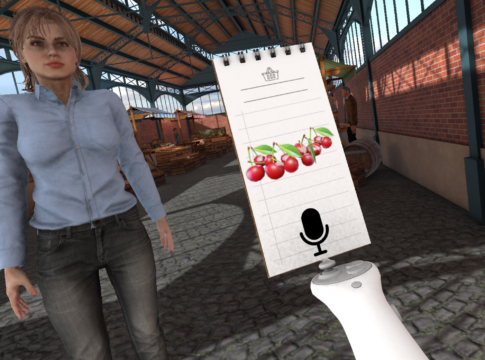
La réalité virtuelle pour combattre les troubles du langage
Evaluation linguistique dans des contextes communicatifs
Certains patients signalent un écart entre leurs performances dans le milieu médical et dans leur vie quotidienne.
Les...
Soulager l’anxiété des adolescents
Jeux vidéo pour soulager l’anxiété
Les jeux vidéo dédiés à la santé mentale sont devenus un outil de choix pour accompagner les adolescents, en...