
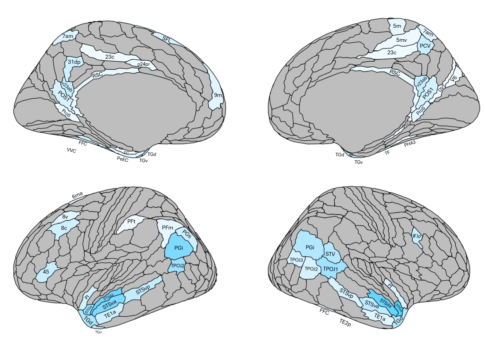
Abstract Very preterm birth (VPT; <32 weeks’ gestation) leads to a situation where crucial steps of brain development occur in an abnormal ex utero environment, translating to vulnerable cortical and subcortical development. Associated with this atypical brain development, children and adolescents born VPT are at a high risk of socio-emotional difficulties. In the current study, we unravel developmental changes in cortical gray matter (GM) concentration in VPT and term-born controls aged 6–14 years, together with their associations with socio-emotional abilities. T1-weighted images were used to estimate signal intensities of brain tissue types in a single voxel (GM, white matter, and cortico-spinal fluid) and extract GM concentration disentangled from the presence of partial volume effects (PVEs). General linear model analysis was used to compare groups. Socio-emotional abilities were assessed and associations with GM concentration were explored using univariate and multivariate analyses. The effects of prematurity were far-reaching, with intricated patterns of increases and decreases of GM concentration mainly in frontal, temporal, parietal, and cingular regions. Better socio-emotional abilities were associated with increased GM concentration in regions known to be involved in such process for both groups. Our findings suggest that the trajectory of brain development following VPT birth may be fundamentally distinctive and impact socio-emotional abilities.
Publication scientifique
Cortical alterations after very preterm birth and the association with socio-emotional abilities from childhood to early adolescence
Autres publications de la plateforme
Causal disconnectomics of motion perception networks: insights from transcranial magnetic stimulation‐induced...
Raffin, Estelle; Salamanca‐Giron, Roberto F.; Huxlin, Krystel R.; Reynaud, Olivier; Mattera, Loan; Martuzzi, Roberto; Hummel, Friedhelm C.
The Journal of Physiology
Boosting hemianopia recovery: the power of interareal cross-frequency brain stimulation
Raffin, Estelle; Bevilacqua, Michele; Windel, Fabienne; Menoud, Pauline; Salamanca-Giron, Roberto F; Feroldi, Sarah; Zandvliet, Sarah B; Ramdass, Nicola; Draaisma, Laurijn; Vuilleumier, Patrik; Guggisberg, Adrian G; Bonvin, Christophe; Fleury, Lisa; Huxlin, Krystel R; Beanato, Elena; Hummel, Friedhelm C
Brain
A graphical pipeline platform for MRS data processing and analysis: MRSpecLAB
Xiao, Ying; Kaiser, Antonia; Kockisch, Matthias; Back, Alex; Carlet, Robin; Liu, Xinyu; Huang, Zhiwei; Döring, André; Widmaier, Mark; Xin, Lijing
Frontiers in Neuroimaging
Brain activation for language and its relationship to cognitive and linguistic...
Balboni, Irene; Rampinini, Alessandra; Kepinska, Olga; Berthele, Raphael; Golestani, Narly
Cerebral Cortex
Resting-state functional connectivity abnormalities in subjective cognitive decline: A 7T MRI...
Pievani, M.; Ribaldi, F.; Toussas, K.; Da Costa, S.; Jorge, J.; Reynaud, O.; Chicherio, C.; Blouin, J.L.; Scheffler, M.; Garibotto, V.; Jovicich, J.; Jelescu, I.O.; Frisoni, G.B.
Neurobiology of Aging
Translational research approach to social orienting deficits in autism: the role...
Contestabile, Alessandro; Kojovic, Nada; Casarotto, Giulia; Delavari, Farnaz; Hagmann, Patric; Schaer, Marie; Bellone, Camilla
Molecular Psychiatry
Journal de publication
Cerebral Cortex
Auteurs:
Siffredi, Vanessa; Liverani, Maria Chiara; Borradori-Tolsa, Cristina; Leuchter, Russia Hà-Vinh; Thiran, Jean-Philippe; Hüppi, Petra S; Fischi-Gómez, Elda
Date de publication:
Plateforme:
Études récentes de la plateforme

Restaurer le mouvement après une paralysie
Stimulation électrique de la moëlle épinière
Un réseau d’électrodes implantables, connecté à un stimulateur implanté, délivre des impulsions électriques aux différents nerfs spinaux.
Chaque...
Pourquoi certains cerveaux adorent apprendre les langues
Aptitude au langage dans le cerveau et le comportement
Les participants réalisent un protocole d’IRM complet, nous permettant d’étudier à la fois la structure...

Reconstruire l’esprit de nos ancêtres
Étudier la cognition physique dans la phylogénie
Tester les individus dans leur environnement naturel permet d’offrir un cadre écologiquement valide à l’étude de la cognition.Pour...