
ABSTRACT GABAergic interneurons are key regulators of cortical circuit function. Among the dozens of reported transcriptionally distinct subtypes of cortical interneurons, neurogliaform cells (NGCs) are unique: they are recruited by long-range excitatory inputs, are a source of slow cortical inhibition and are able to modulate the activity of large neuronal populations. Despite their functional relevance, the developmental emergence and diversity of NGCs remains unclear. Here, by combining single-cell transcriptomics, genetic fate mapping, and electrophysiological and morphological characterization, we reveal that discrete molecular subtypes of NGCs, with distinctive anatomical and molecular profiles, populate the mouse neocortex. Furthermore, we show that NGC subtypes emerge gradually through development, as incipient discriminant molecular signatures are apparent in preoptic area (POA)-born NGC precursors. By identifying NGC developmentally conserved transcriptional programs, we report that the transcription factor Tox2 constitutes an identity hallmark across NGC subtypes. Using CRISPR-Cas9-mediated genetic loss of function, we show that Tox2 is essential for NGC development: POA-born cells lacking Tox2 fail to differentiate into NGCs. Together, these results reveal that NGCs are born from a spatially restricted pool of Tox2+ POA precursors, after which intra-type diverging molecular programs are gradually acquired post-mitotically and result in functionally and molecularly discrete NGC cortical subtypes.
Publication scientifique
Developmental emergence of cortical neurogliaform cell diversity
Autres publications de la plateforme
Molecular programs guiding arealization of descending cortical pathways
Abe, Philipp; Lavalley, Adrien; Morassut, Ilaria; Santinha, Antonio J.; Roig-Puiggros, Sergi; Javed, Awais; Klingler, Esther; Baumann, Natalia; Prados, Julien; Platt, Randall J.; Jabaudon, Denis
Nature
Developmental emergence of first- and higher-order thalamic neuron molecular identities
Lo Giudice, Quentin; Wagener, Robin J.; Abe, Philipp; Frangeul, Laura; Jabaudon, Denis
Development
Regional differences in progenitor metabolism shape brain growth during development
Baumann, Natalia; Wagener, Robin J.; Javed, Awais; Conti, Eleonora; Abe, Philipp; Lopes, Andrea; Sansevrino, Roberto; Lavalley, Adrien; Magrinelli, Elia; Szalai, Timea; Fuciec, Daniel; Ferreira, Clothilde; Fièvre, Sabine; Fouassier, Andreane; D’Amico, Davide; Harschnitz, Oliver; Jabaudon, Denis
Cell
Single-cell genotyping and transcriptomic profiling of mosaic focal cortical dysplasia
Baldassari, Sara; Klingler, Esther; Teijeiro, Lucia Gomez; Doladilhe, Marion; Raoux, Corentin; Roig-Puiggros, Sergi; Bizzotto, Sara; Couturier, Jeanne; Gilbert, Alice; Sami, Lina; Ribierre, Théo; Aronica, Eleonora; Adle-Biassette, Homa; Chipaux, Mathilde; Jabaudon, Denis; Baulac, Stéphanie
Nature Neuroscience
Dual lineage origins contribute to neocortical astrocyte diversity
Zhou, Jiafeng; Vitali, Ilaria; Roig-Puiggros, Sergi; Javed, Awais; Cantando, Iva; Puglisi, Matteo; Bezzi, Paola; Jabaudon, Denis; Mayer, Christian; Bocchi, Riccardo
Nature Communications
Targeting pathological cells with senolytic drugs reduces seizures in neurodevelopmental mTOR-related...
Ribierre, Théo; Bacq, Alexandre; Donneger, Florian; Doladilhe, Marion; Maletic, Marina; Roussel, Delphine; Le Roux, Isabelle; Chassoux, Francine; Devaux, Bertrand; Adle-Biassette, Homa; Ferrand-Sorbets, Sarah; Dorfmüller, Georg; Chipaux, Mathilde; Baldassari, Sara; Poncer, Jean-Christophe; Baulac, Stéphanie
Nature Neuroscience
Journal de publication
Development
Auteurs:
Gomez, Lucia; Cadilhac, Christelle; Prados, Julien; Mule, Nandkishor; Jabaudon, Denis; Dayer, Alexandre
Date de publication:
Plateforme:
Études récentes de la plateforme
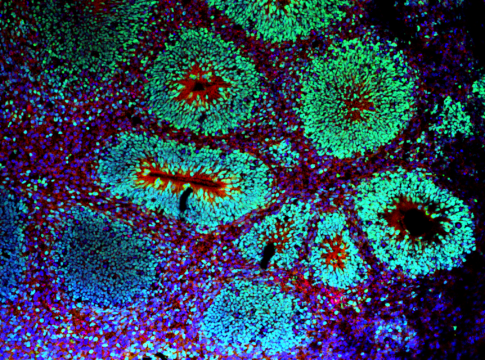
Reprogrammer des cellules humaines pour étudier les défauts du cerveau
Organoïdes cérébraux pour les troubles mentaux
Nous utilisons une approche appelée organoïdes cérébraux (« cerveau dans une boîte de Petri ») qui permet de...
Suivi de la dopamine dans la maladie de Parkinson
Détection de la dopamine grâce à des biosenseurs à base d’ADN
Une approche innovante utilise des brins d’ADN artificiellement conçus, appelés aptamères, qui capturent...
Suivre la trace des biomarqueurs sanguins de la maladie d’Alzheimer
Réinventer le diagnostic de la maladie d'Alzheimer
La maladie d’Alzheimer se développe des décennies avant l’apparition des symptômes.
Des recherches récentes suggèrent que le risque...