

The human capacity to compute the likelihood that a decision is correct—known as metacognition—has proven difficult to study in isolation as it usually cooccurs with decision making. Here, we isolated postdecisional from decisional contributions to metacognition by analyzing neural correlates of confidence with multimodal imaging. Healthy volunteers reported their confidence in the accuracy of decisions they made or decisions they observed. We found better metacognitive performance for committed vs. observed decisions, indicating that committing to a decision may improve confidence. Relying on concurrent electroencephalography and hemodynamic recordings, we found a common correlate of confidence following committed and observed decisions in the inferior frontal gyrus and a dissociation in the anterior prefrontal cortex and anterior insula. We discuss these results in light of decisional and postdecisional accounts of confidence and propose a computational model of confidence in which metacognitive performance naturally improves when evidence accumulation is constrained upon committing a decision.
Publication scientifique
Disentangling the origins of confidence in speeded perceptual judgments through multimodal imaging
Autres publications de la plateforme
Causal disconnectomics of motion perception networks: insights from transcranial magnetic stimulation‐induced...
Raffin, Estelle; Salamanca‐Giron, Roberto F.; Huxlin, Krystel R.; Reynaud, Olivier; Mattera, Loan; Martuzzi, Roberto; Hummel, Friedhelm C.
The Journal of Physiology
Boosting hemianopia recovery: the power of interareal cross-frequency brain stimulation
Raffin, Estelle; Bevilacqua, Michele; Windel, Fabienne; Menoud, Pauline; Salamanca-Giron, Roberto F; Feroldi, Sarah; Zandvliet, Sarah B; Ramdass, Nicola; Draaisma, Laurijn; Vuilleumier, Patrik; Guggisberg, Adrian G; Bonvin, Christophe; Fleury, Lisa; Huxlin, Krystel R; Beanato, Elena; Hummel, Friedhelm C
Brain
Return of the GEDAI: Unsupervised EEG Denoising based on Leadfield Filtering
Ros, Tomas; Férat, Victor; Huang, Yingqi; Colangelo, Cristina; Kia, Seyed Mostafa; Wolfers, Thomas; Vulliemoz, Serge; Michela, Abele
Multivariate deep phenotyping reveals behavioral correlates of non-restorative sleep in 22q11.2...
Reich, Natacha; Imparato, Andrea; Cataldi, Jacinthe; Thillainathan, Niveettha; Delavari, Farnaz; Schneider, Maude; Eliez, Stephan; Siclari, Francesca; Sandini, Corrado
Psychiatry Research
EEG microstate D as psychosis-specific correlate in adolescents and young adults...
Liebrand, Matthias; Katsarakis, Angelos; Josi, Johannes; Diezig, Sarah; Michel, Chantal; Schultze-Lutter, Frauke; Rochas, Vincent; Mancini, Valentina; Kaess, Michael; Hubl, Daniela; Koenig, Thomas; Kindler, Jochen
Schizophrenia Research
EEG correlates of egocentric and altercentric biases in forensic cases with...
Rochas, Vincent; Montandon, Marie-Louise; Rodriguez, Cristelle; Herrmann, François R.; Eytan, Ariel; Pegna, Alan J.; Michel, Christoph M.; Giannakopoulos, Panteleimon
Frontiers in Neuroscience
Journal de publication
Proceedings of the National Academy of Sciences
Auteurs:
Pereira, Michael; Faivre, Nathan; Iturrate, Iñaki; Wirthlin, Marco; Serafini, Luana; Martin, Stéphanie; Desvachez, Arnaud; Blanke, Olaf; Van De Ville, Dimitri; Millán, José Del R.
Date de publication:
Plateforme:
Études récentes de la plateforme
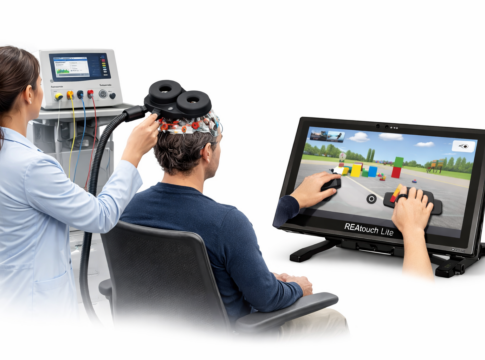
Améliorer la récupération motrice du bras après un AVC
Stimuler les réseaux cérébraux pour la récupération
INSPIRE utilise une technique de stimulation cérébrale non invasive pour activer les zones clés du cerveau impliquées...

Restaurer le mouvement après une paralysie
Stimulation électrique de la moëlle épinière
Un réseau d’électrodes implantables, connecté à un stimulateur implanté, délivre des impulsions électriques aux différents nerfs spinaux.
Chaque...
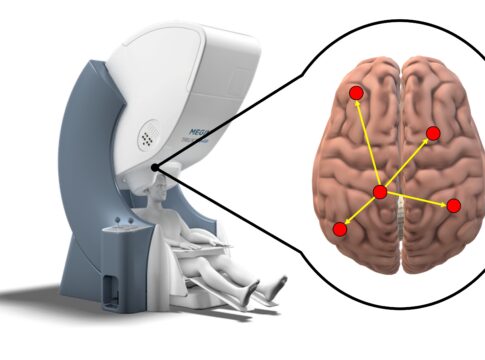
Comment les souvenirs évoluent-ils avec le temps ?
Une fenêtre sur le cerveau
La magnétoencéphalographie (MEG) nous permet d’enregistrer l’activité neuronale avec une grande précision spatiale et temporelle.
Nous utilisons cette technique...