

Abstract Acute physical exercise improves memory functions by increasing neural plasticity in the hippocampus. In animals, a single session of physical exercise has been shown to boost anandamide (AEA), an endocannabinoid known to promote hippocampal plasticity. Hippocampal neuronal networks encode episodic memory representations, including the temporal organization of elements, and can thus benefit motor sequence learning. While previous work established that acute physical exercise has positive effects on declarative memory linked to hippocampal plasticity mechanisms, its influence on memory for motor sequences, and especially on neural mechanisms underlying possible effects, has been less investigated. Here we studied the impact of acute physical exercise on motor sequence learning, and its underlying neurophysiological mechanisms in humans, using a cross-over randomized within-subjects design. We measured behavior, fMRI activity, and circulating AEA levels in fifteen healthy participants while they performed a serial reaction time task before and after a short period of exercise (moderate or high intensity) or rest. We show that exercise enhanced motor sequence memory, significantly for high intensity exercise and tending towards significance for moderate intensity exercise. This enhancement correlated with AEA increase, and dovetailed with local increases in caudate nucleus and hippocampus activity. These findings demonstrate that acute physical exercise promotes sequence learning, thus attesting the overarching benefit of exercise to hippocampus-related memory functions.
Publication scientifique
Effect of acute physical exercise on motor sequence memory
Autres publications de la plateforme
Causal disconnectomics of motion perception networks: insights from transcranial magnetic stimulation‐induced...
Raffin, Estelle; Salamanca‐Giron, Roberto F.; Huxlin, Krystel R.; Reynaud, Olivier; Mattera, Loan; Martuzzi, Roberto; Hummel, Friedhelm C.
The Journal of Physiology
Boosting hemianopia recovery: the power of interareal cross-frequency brain stimulation
Raffin, Estelle; Bevilacqua, Michele; Windel, Fabienne; Menoud, Pauline; Salamanca-Giron, Roberto F; Feroldi, Sarah; Zandvliet, Sarah B; Ramdass, Nicola; Draaisma, Laurijn; Vuilleumier, Patrik; Guggisberg, Adrian G; Bonvin, Christophe; Fleury, Lisa; Huxlin, Krystel R; Beanato, Elena; Hummel, Friedhelm C
Brain
Return of the GEDAI: Unsupervised EEG Denoising based on Leadfield Filtering
Ros, Tomas; Férat, Victor; Huang, Yingqi; Colangelo, Cristina; Kia, Seyed Mostafa; Wolfers, Thomas; Vulliemoz, Serge; Michela, Abele
Multivariate deep phenotyping reveals behavioral correlates of non-restorative sleep in 22q11.2...
Reich, Natacha; Imparato, Andrea; Cataldi, Jacinthe; Thillainathan, Niveettha; Delavari, Farnaz; Schneider, Maude; Eliez, Stephan; Siclari, Francesca; Sandini, Corrado
Psychiatry Research
EEG microstate D as psychosis-specific correlate in adolescents and young adults...
Liebrand, Matthias; Katsarakis, Angelos; Josi, Johannes; Diezig, Sarah; Michel, Chantal; Schultze-Lutter, Frauke; Rochas, Vincent; Mancini, Valentina; Kaess, Michael; Hubl, Daniela; Koenig, Thomas; Kindler, Jochen
Schizophrenia Research
EEG correlates of egocentric and altercentric biases in forensic cases with...
Rochas, Vincent; Montandon, Marie-Louise; Rodriguez, Cristelle; Herrmann, François R.; Eytan, Ariel; Pegna, Alan J.; Michel, Christoph M.; Giannakopoulos, Panteleimon
Frontiers in Neuroscience
Journal de publication
Scientific Reports
Auteurs:
Marin Bosch, Blanca; Bringard, Aurélien; Logrieco, Maria Grazia; Lauer, Estelle; Imobersteg, Nathalie; Thomas, Aurélien; Ferretti, Guido; Schwartz, Sophie; Igloi, Kinga
Date de publication:
Plateforme:
Études récentes de la plateforme
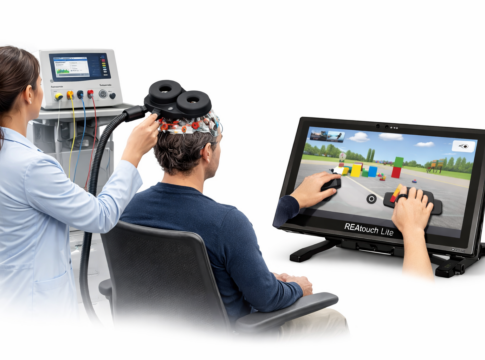
Améliorer la récupération motrice du bras après un AVC
Stimuler les réseaux cérébraux pour la récupération
INSPIRE utilise une technique de stimulation cérébrale non invasive pour activer les zones clés du cerveau impliquées...

Restaurer le mouvement après une paralysie
Stimulation électrique de la moëlle épinière
Un réseau d’électrodes implantables, connecté à un stimulateur implanté, délivre des impulsions électriques aux différents nerfs spinaux.
Chaque...
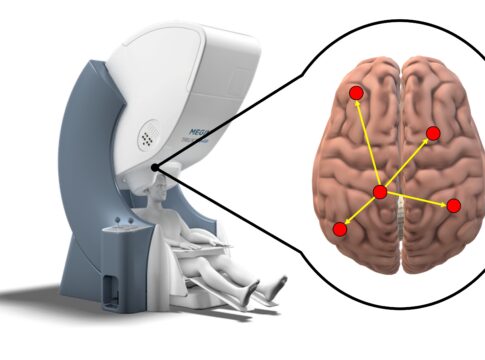
Comment les souvenirs évoluent-ils avec le temps ?
Une fenêtre sur le cerveau
La magnétoencéphalographie (MEG) nous permet d’enregistrer l’activité neuronale avec une grande précision spatiale et temporelle.
Nous utilisons cette technique...