

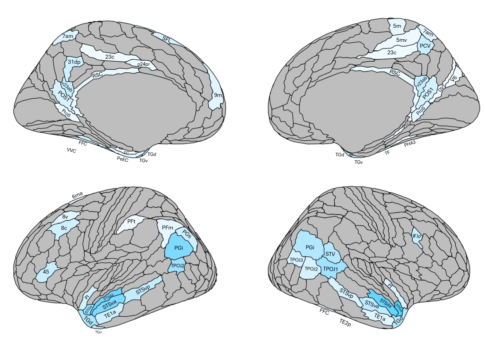
Abstract Discrimination and integration of motion direction requires the interplay of multiple brain areas. Theoretical accounts of perception suggest that stimulus-related (i.e., exogenous) and decision-related (i.e., endogenous) factors affect distributed neuronal processing at different levels of the visual hierarchy. To test these predictions, we measured brain activity of healthy participants during a motion discrimination task, using electroencephalography (EEG) and functional magnetic resonance imaging (fMRI). We independently modeled the impact of exogenous factors (task demand) and endogenous factors (perceptual decision-making) on the activity of the motion discrimination network and applied Dynamic Causal Modeling (DCM) to both modalities. DCM for event-related potentials (DCM-ERP) revealed that task demand impacted the reciprocal connections between the primary visual cortex (V1) and medial temporal areas (V5). With practice, higher visual areas were increasingly involved, as revealed by DCM-fMRI. Perceptual decision-making modulated higher levels (e.g., V5-to-Frontal Eye Fields, FEF), in a manner predictive of performance. Our data suggest that lower levels of the visual network support early, feature-based selection of responses, especially when learning strategies have not been implemented. In contrast, perceptual decision-making operates at higher levels of the visual hierarchy by integrating sensory information with the internal state of the subject.
Publication scientifique
Functional segregation within the dorsal frontoparietal network: a multimodal dynamic causal modeling study
Autres publications de la plateforme
Causal disconnectomics of motion perception networks: insights from transcranial magnetic stimulation‐induced...
Raffin, Estelle; Salamanca‐Giron, Roberto F.; Huxlin, Krystel R.; Reynaud, Olivier; Mattera, Loan; Martuzzi, Roberto; Hummel, Friedhelm C.
The Journal of Physiology
Boosting hemianopia recovery: the power of interareal cross-frequency brain stimulation
Raffin, Estelle; Bevilacqua, Michele; Windel, Fabienne; Menoud, Pauline; Salamanca-Giron, Roberto F; Feroldi, Sarah; Zandvliet, Sarah B; Ramdass, Nicola; Draaisma, Laurijn; Vuilleumier, Patrik; Guggisberg, Adrian G; Bonvin, Christophe; Fleury, Lisa; Huxlin, Krystel R; Beanato, Elena; Hummel, Friedhelm C
Brain
A graphical pipeline platform for MRS data processing and analysis: MRSpecLAB
Xiao, Ying; Kaiser, Antonia; Kockisch, Matthias; Back, Alex; Carlet, Robin; Liu, Xinyu; Huang, Zhiwei; Döring, André; Widmaier, Mark; Xin, Lijing
Frontiers in Neuroimaging
Brain activation for language and its relationship to cognitive and linguistic...
Balboni, Irene; Rampinini, Alessandra; Kepinska, Olga; Berthele, Raphael; Golestani, Narly
Cerebral Cortex
Resting-state functional connectivity abnormalities in subjective cognitive decline: A 7T MRI...
Pievani, M.; Ribaldi, F.; Toussas, K.; Da Costa, S.; Jorge, J.; Reynaud, O.; Chicherio, C.; Blouin, J.L.; Scheffler, M.; Garibotto, V.; Jovicich, J.; Jelescu, I.O.; Frisoni, G.B.
Neurobiology of Aging
Translational research approach to social orienting deficits in autism: the role...
Contestabile, Alessandro; Kojovic, Nada; Casarotto, Giulia; Delavari, Farnaz; Hagmann, Patric; Schaer, Marie; Bellone, Camilla
Molecular Psychiatry
Journal de publication
Cerebral Cortex
Auteurs:
Raffin, Estelle; Witon, Adrien; Salamanca-Giron, Roberto F; Huxlin, Krystel R; Hummel, Friedhelm C
Date de publication:
Plateforme:
Études récentes de la plateforme

Restaurer le mouvement après une paralysie
Stimulation électrique de la moëlle épinière
Un réseau d’électrodes implantables, connecté à un stimulateur implanté, délivre des impulsions électriques aux différents nerfs spinaux.
Chaque...
Pourquoi certains cerveaux adorent apprendre les langues
Aptitude au langage dans le cerveau et le comportement
Les participants réalisent un protocole d’IRM complet, nous permettant d’étudier à la fois la structure...
Imagerie du développement du système de défense du cerveau
Imagerie multimodale : tirer sur une cible en mouvement
L'IRM à haut champ révèle des détails vasculaires et structuraux fins, tandis que la SRM...