
Abstract Introduction Orbitofrontal reality filtering (ORFi) is a memory mechanism that distinguishes whether a thought is relevant to present reality or not. In adults, it is mediated by the orbitofrontal cortex (OFC). This region is still not fully developed in preteenagers, but ORFi is already active from age 7. Here, we probe the neural correlates of ORFi in early adolescents, hypothesizing that OFC mediates the sense of reality in this population. Methods Functional magnetic resonance images (fMRI) were acquired in 22 early adolescents during a task composed of two runs: run 1 measuring recognition capacity; run 2 measuring ORFi; each containing two types of images (conditions): distractors (D: images seen for the first time in the current run) and targets (T: images seen for the second time in the current run). Group region of interest (ROI) analysis was performed in a flexible factorial design with two factors (run and condition) using SPM12. Results We found significant main effects for the experimental run and condition. The bilateral OFC activation was higher during ORFi than during the first run. Additionally, the OFC was more active while processing distractors than targets. Conclusion These results confirm, for the first time, the role of OFC in reality filtering in early adolescents.
Publication scientifique
Get real: Orbitofrontal cortex mediates the ability to sense reality in early adolescents
Autres publications de la plateforme
Causal disconnectomics of motion perception networks: insights from transcranial magnetic stimulation‐induced...
Raffin, Estelle; Salamanca‐Giron, Roberto F.; Huxlin, Krystel R.; Reynaud, Olivier; Mattera, Loan; Martuzzi, Roberto; Hummel, Friedhelm C.
The Journal of Physiology
Boosting hemianopia recovery: the power of interareal cross-frequency brain stimulation
Raffin, Estelle; Bevilacqua, Michele; Windel, Fabienne; Menoud, Pauline; Salamanca-Giron, Roberto F; Feroldi, Sarah; Zandvliet, Sarah B; Ramdass, Nicola; Draaisma, Laurijn; Vuilleumier, Patrik; Guggisberg, Adrian G; Bonvin, Christophe; Fleury, Lisa; Huxlin, Krystel R; Beanato, Elena; Hummel, Friedhelm C
Brain
A graphical pipeline platform for MRS data processing and analysis: MRSpecLAB
Xiao, Ying; Kaiser, Antonia; Kockisch, Matthias; Back, Alex; Carlet, Robin; Liu, Xinyu; Huang, Zhiwei; Döring, André; Widmaier, Mark; Xin, Lijing
Frontiers in Neuroimaging
Brain activation for language and its relationship to cognitive and linguistic...
Balboni, Irene; Rampinini, Alessandra; Kepinska, Olga; Berthele, Raphael; Golestani, Narly
Cerebral Cortex
Resting-state functional connectivity abnormalities in subjective cognitive decline: A 7T MRI...
Pievani, M.; Ribaldi, F.; Toussas, K.; Da Costa, S.; Jorge, J.; Reynaud, O.; Chicherio, C.; Blouin, J.L.; Scheffler, M.; Garibotto, V.; Jovicich, J.; Jelescu, I.O.; Frisoni, G.B.
Neurobiology of Aging
Translational research approach to social orienting deficits in autism: the role...
Contestabile, Alessandro; Kojovic, Nada; Casarotto, Giulia; Delavari, Farnaz; Hagmann, Patric; Schaer, Marie; Bellone, Camilla
Molecular Psychiatry
Journal de publication
Brain and Behavior
Auteurs:
Liverani, Maria Chiara; Freitas, Lorena G. A.; Siffredi, Vanessa; Mikneviciute, Greta; Martuzzi, Roberto; Meskaldij, Djalel‐Eddine; Borradori Tolsa, Cristina; Ha‐Vinh Leuchter, Russia; Schnider, Armin; Van De Ville, Dimitri; Hüppi, Petra Susan
Date de publication:
Plateforme:
Études récentes de la plateforme

Restaurer le mouvement après une paralysie
Stimulation électrique de la moëlle épinière
Un réseau d’électrodes implantables, connecté à un stimulateur implanté, délivre des impulsions électriques aux différents nerfs spinaux.
Chaque...
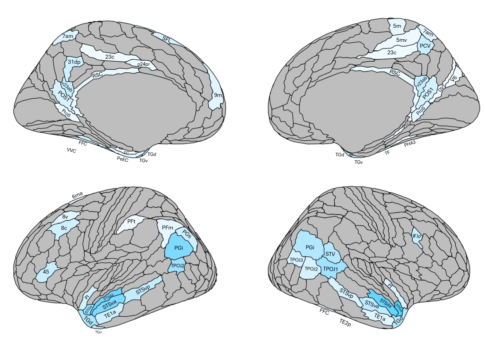
Pourquoi certains cerveaux adorent apprendre les langues
Aptitude au langage dans le cerveau et le comportement
Les participants réalisent un protocole d’IRM complet, nous permettant d’étudier à la fois la structure...

Reconstruire l’esprit de nos ancêtres
Étudier la cognition physique dans la phylogénie
Tester les individus dans leur environnement naturel permet d’offrir un cadre écologiquement valide à l’étude de la cognition.Pour...