

Abstract Homonymous hemianopia (HH), a common visual impairment resulting from occipital lobe lesions, affects a significant number of stroke survivors. Intensive perceptual training can foster recovery, possibly by enhancing surviving visual pathways. This study employed cortico-cortical paired associative stimulation (ccPAS) to induce associative plasticity within the residual and bidirectional primary visual cortex (V1)-middle temporal area (MT) pathways in stroke patients. We used ccPAS, which is thought to tap into Hebbian-like spike-timing dependent plasticity, over a motion processing pathway in stroke patients to transiently improve visual motion discrimination in their blind field. Sixteen stroke patients participated in this double-blind, crossover study comparing the effects of bidirectional ccPAS (V1-to-MT or MT-to-V1) on motion discrimination and EEG-Granger Causality. Additionally, we explored potential multimodal sources of inter-individual variability. Results showed that MT-to-V1 ccPAS enhanced motion direction discrimination, but the expected electrophysiological increase in top-down MT-to-V1 inputs was observed only in patients who showed improvement in motion discrimination. Good responders to MT-V1 ccPAS also demonstrated improved functional coupling between the cortical motion pathway and other relevant areas in the visual network, as well as more preserved ipsilesional V1-MT structural integrity. These findings indicate that targeted ccPAS can effectively engage functionally relevant residual visual pathways in stroke-affected brains, potentially offering new avenues for patient stratification and visual recovery strategies.
Publication scientifique
Pathway-dependent brain stimulation responses indicate motion processing integrity after stroke
Autres publications de la plateforme
Causal disconnectomics of motion perception networks: insights from transcranial magnetic stimulation‐induced...
Raffin, Estelle; Salamanca‐Giron, Roberto F.; Huxlin, Krystel R.; Reynaud, Olivier; Mattera, Loan; Martuzzi, Roberto; Hummel, Friedhelm C.
The Journal of Physiology
Boosting hemianopia recovery: the power of interareal cross-frequency brain stimulation
Raffin, Estelle; Bevilacqua, Michele; Windel, Fabienne; Menoud, Pauline; Salamanca-Giron, Roberto F; Feroldi, Sarah; Zandvliet, Sarah B; Ramdass, Nicola; Draaisma, Laurijn; Vuilleumier, Patrik; Guggisberg, Adrian G; Bonvin, Christophe; Fleury, Lisa; Huxlin, Krystel R; Beanato, Elena; Hummel, Friedhelm C
Brain
Return of the GEDAI: Unsupervised EEG Denoising based on Leadfield Filtering
Ros, Tomas; Férat, Victor; Huang, Yingqi; Colangelo, Cristina; Kia, Seyed Mostafa; Wolfers, Thomas; Vulliemoz, Serge; Michela, Abele
Multivariate deep phenotyping reveals behavioral correlates of non-restorative sleep in 22q11.2...
Reich, Natacha; Imparato, Andrea; Cataldi, Jacinthe; Thillainathan, Niveettha; Delavari, Farnaz; Schneider, Maude; Eliez, Stephan; Siclari, Francesca; Sandini, Corrado
Psychiatry Research
EEG microstate D as psychosis-specific correlate in adolescents and young adults...
Liebrand, Matthias; Katsarakis, Angelos; Josi, Johannes; Diezig, Sarah; Michel, Chantal; Schultze-Lutter, Frauke; Rochas, Vincent; Mancini, Valentina; Kaess, Michael; Hubl, Daniela; Koenig, Thomas; Kindler, Jochen
Schizophrenia Research
EEG correlates of egocentric and altercentric biases in forensic cases with...
Rochas, Vincent; Montandon, Marie-Louise; Rodriguez, Cristelle; Herrmann, François R.; Eytan, Ariel; Pegna, Alan J.; Michel, Christoph M.; Giannakopoulos, Panteleimon
Frontiers in Neuroscience
Journal de publication
Brain
Auteurs:
Bevilacqua, Michele; Windel, Fabienne; Beanato, Elena; Menoud, Pauline; Zandvliet, Sarah; Ramdass, Nicola; Fleury, Lisa; Hervé, Julie; Huxlin, Krystel R; Hummel, Friedhelm C; Raffin, Estelle
Date de publication:
Plateforme:
Études récentes de la plateforme
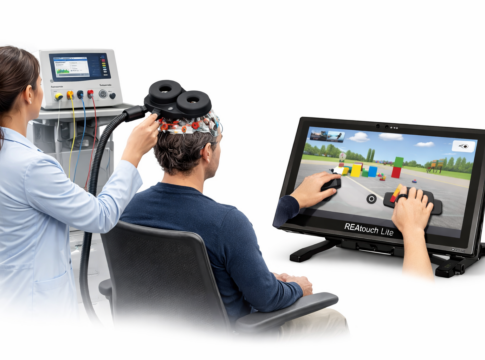
Améliorer la récupération motrice du bras après un AVC
Stimuler les réseaux cérébraux pour la récupération
INSPIRE utilise une technique de stimulation cérébrale non invasive pour activer les zones clés du cerveau impliquées...

Restaurer le mouvement après une paralysie
Stimulation électrique de la moëlle épinière
Un réseau d’électrodes implantables, connecté à un stimulateur implanté, délivre des impulsions électriques aux différents nerfs spinaux.
Chaque...
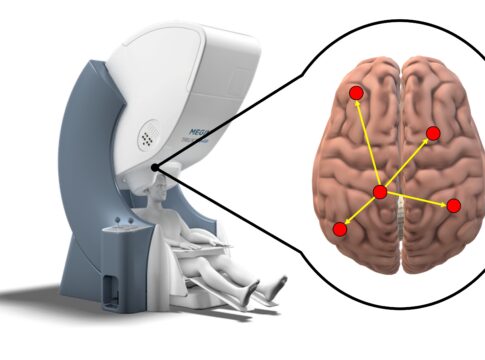
Comment les souvenirs évoluent-ils avec le temps ?
Une fenêtre sur le cerveau
La magnétoencéphalographie (MEG) nous permet d’enregistrer l’activité neuronale avec une grande précision spatiale et temporelle.
Nous utilisons cette technique...