
The subjective experience of self-awareness is attributed to the human capacity for introspective thought during periods of mind-wandering. However, how this cognitive function is impacted in individuals with mild cognitive impairment (MCI) still needs to be better understood. To address this gap, we investigated alterations in self-referential thinking in a cohort of 30 MCI patients, comparing them to 60 healthy old-aged and 60 healthy younger controls. MCI patients exhibited a notable decline in overall cognitive function, as evidenced by significantly lower scores on the Montreal Cognitive Assessment (MoCA), with particular deficits in Memory subscore and Memory Index Score (MIS). Employing the Amsterdam Resting-State Questionnaire (ARSQ) to assess mind-wandering, we observed diminished self-related thoughts relating to personal past experiences and future thinking among MCI patients. Notably, using high-density electroencephalography (hdEEG) microstate analysis, we detected reduced neural activity for microstate C associated with self-related thoughts in MCI patients and healthy older relative to healthy younger controls, and an increase in neural activity for microstate A in MCI patients compared to healthy older and younger controls. This aberrant temporal activity was localized within brain regions implicated in episodic autobiographical memory and the default mode network. Our results highlight a link between impaired mind-wandering ability and dysfunction within the intrinsic neural networks of MCI patients, underscoring its implications for disruptions in the sense of self within this clinical population.
Publication scientifique
Self-related thought alterations associated with intrinsic brain dysfunction in mild cognitive impairment
Autres publications de la plateforme
Causal disconnectomics of motion perception networks: insights from transcranial magnetic stimulation‐induced...
Raffin, Estelle; Salamanca‐Giron, Roberto F.; Huxlin, Krystel R.; Reynaud, Olivier; Mattera, Loan; Martuzzi, Roberto; Hummel, Friedhelm C.
The Journal of Physiology
Boosting hemianopia recovery: the power of interareal cross-frequency brain stimulation
Raffin, Estelle; Bevilacqua, Michele; Windel, Fabienne; Menoud, Pauline; Salamanca-Giron, Roberto F; Feroldi, Sarah; Zandvliet, Sarah B; Ramdass, Nicola; Draaisma, Laurijn; Vuilleumier, Patrik; Guggisberg, Adrian G; Bonvin, Christophe; Fleury, Lisa; Huxlin, Krystel R; Beanato, Elena; Hummel, Friedhelm C
Brain
Return of the GEDAI: Unsupervised EEG Denoising based on Leadfield Filtering
Ros, Tomas; Férat, Victor; Huang, Yingqi; Colangelo, Cristina; Kia, Seyed Mostafa; Wolfers, Thomas; Vulliemoz, Serge; Michela, Abele
Multivariate deep phenotyping reveals behavioral correlates of non-restorative sleep in 22q11.2...
Reich, Natacha; Imparato, Andrea; Cataldi, Jacinthe; Thillainathan, Niveettha; Delavari, Farnaz; Schneider, Maude; Eliez, Stephan; Siclari, Francesca; Sandini, Corrado
Psychiatry Research
EEG microstate D as psychosis-specific correlate in adolescents and young adults...
Liebrand, Matthias; Katsarakis, Angelos; Josi, Johannes; Diezig, Sarah; Michel, Chantal; Schultze-Lutter, Frauke; Rochas, Vincent; Mancini, Valentina; Kaess, Michael; Hubl, Daniela; Koenig, Thomas; Kindler, Jochen
Schizophrenia Research
EEG correlates of egocentric and altercentric biases in forensic cases with...
Rochas, Vincent; Montandon, Marie-Louise; Rodriguez, Cristelle; Herrmann, François R.; Eytan, Ariel; Pegna, Alan J.; Michel, Christoph M.; Giannakopoulos, Panteleimon
Frontiers in Neuroscience
Journal de publication
Scientific Reports
Auteurs:
Tarailis, Povilas; Lory, Kim; Unschuld, Paul G.; Michel, Christoph M.; Bréchet, Lucie
Date de publication:
Plateforme:
Études récentes de la plateforme
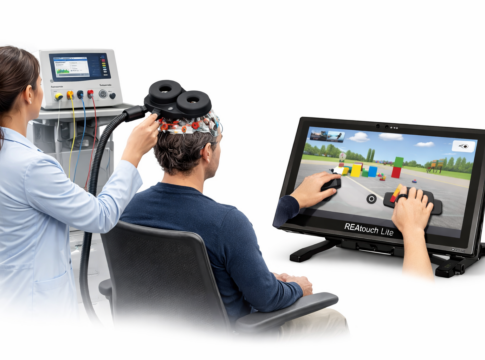
Améliorer la récupération motrice du bras après un AVC
Stimuler les réseaux cérébraux pour la récupération
INSPIRE utilise une technique de stimulation cérébrale non invasive pour activer les zones clés du cerveau impliquées...

Restaurer le mouvement après une paralysie
Stimulation électrique de la moëlle épinière
Un réseau d’électrodes implantables, connecté à un stimulateur implanté, délivre des impulsions électriques aux différents nerfs spinaux.
Chaque...
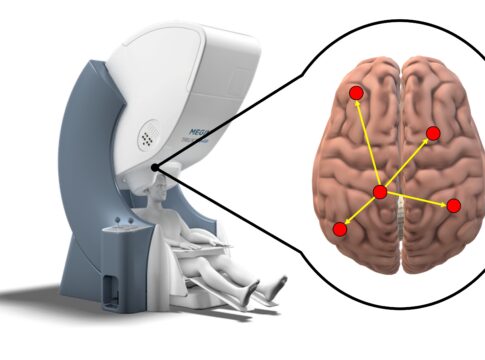
Comment les souvenirs évoluent-ils avec le temps ?
Une fenêtre sur le cerveau
La magnétoencéphalographie (MEG) nous permet d’enregistrer l’activité neuronale avec une grande précision spatiale et temporelle.
Nous utilisons cette technique...