
With the brain, the spinal cord forms the central nervous system. Initially considered a passive relay between the brain and the periphery, the spinal cord is now recognized as being active and plastic. Yet, it remains largely overlooked by the human neuroscience community, in stark contrast with the wealth of research investigating the brain. In this review, we argue that fMRI, traditionally used to image cerebral function, can be extended beyond the brain to help unravel spinal mechanisms involved in human behaviors. To this end, we first outline strategies that have been proposed to tackle the challenges inherent to spinal cord fMRI. Then, we discuss how they have been utilized to provide insights into the functional organization of spinal sensorimotor circuits, highlighting their potential to address fundamental and clinical questions. By summarizing guidelines and applications of spinal cord fMRI, we hope to stimulate and support further research into this promising yet underexplored field.
Publication scientifique
Spinal Cord fMRI: A New Window into the Central Nervous System
Autres publications de la plateforme
Causal disconnectomics of motion perception networks: insights from transcranial magnetic stimulation‐induced...
Raffin, Estelle; Salamanca‐Giron, Roberto F.; Huxlin, Krystel R.; Reynaud, Olivier; Mattera, Loan; Martuzzi, Roberto; Hummel, Friedhelm C.
The Journal of Physiology
Boosting hemianopia recovery: the power of interareal cross-frequency brain stimulation
Raffin, Estelle; Bevilacqua, Michele; Windel, Fabienne; Menoud, Pauline; Salamanca-Giron, Roberto F; Feroldi, Sarah; Zandvliet, Sarah B; Ramdass, Nicola; Draaisma, Laurijn; Vuilleumier, Patrik; Guggisberg, Adrian G; Bonvin, Christophe; Fleury, Lisa; Huxlin, Krystel R; Beanato, Elena; Hummel, Friedhelm C
Brain
A graphical pipeline platform for MRS data processing and analysis: MRSpecLAB
Xiao, Ying; Kaiser, Antonia; Kockisch, Matthias; Back, Alex; Carlet, Robin; Liu, Xinyu; Huang, Zhiwei; Döring, André; Widmaier, Mark; Xin, Lijing
Frontiers in Neuroimaging
Brain activation for language and its relationship to cognitive and linguistic...
Balboni, Irene; Rampinini, Alessandra; Kepinska, Olga; Berthele, Raphael; Golestani, Narly
Cerebral Cortex
Resting-state functional connectivity abnormalities in subjective cognitive decline: A 7T MRI...
Pievani, M.; Ribaldi, F.; Toussas, K.; Da Costa, S.; Jorge, J.; Reynaud, O.; Chicherio, C.; Blouin, J.L.; Scheffler, M.; Garibotto, V.; Jovicich, J.; Jelescu, I.O.; Frisoni, G.B.
Neurobiology of Aging
Translational research approach to social orienting deficits in autism: the role...
Contestabile, Alessandro; Kojovic, Nada; Casarotto, Giulia; Delavari, Farnaz; Hagmann, Patric; Schaer, Marie; Bellone, Camilla
Molecular Psychiatry
Journal de publication
The Neuroscientist
Auteurs:
Kinany, Nawal; Pirondini, Elvira; Micera, Silvestro; Van De Ville, Dimitri
Date de publication:
Plateforme:
Études récentes de la plateforme

Restaurer le mouvement après une paralysie
Stimulation électrique de la moëlle épinière
Un réseau d’électrodes implantables, connecté à un stimulateur implanté, délivre des impulsions électriques aux différents nerfs spinaux.
Chaque...
Pourquoi certains cerveaux adorent apprendre les langues
Aptitude au langage dans le cerveau et le comportement
Les participants réalisent un protocole d’IRM complet, nous permettant d’étudier à la fois la structure...
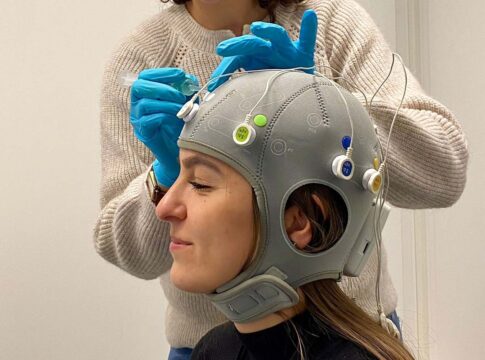
Stimulation cérébrale à domicile pour booster la cognition
Améliorer la cognition
Explorer la stimulation cérébrale non invasive pour soutenir les fonctions exécutives
La stimulation transcrânienne par courant alternatif (tACS) utilise de faibles...