

Abstract Trait anxiety is an important phenotype in the prediction of stress-induced neuropsychiatric disorders. While the role of trait anxiety in mental effort and cognitive impairment is well documented, much less is known about its influence on motivated behaviors and physical effort. Here, we investigated trait anxiety-related differences in behavioral and neural responses in an effort-related monetary incentive delay task. Participants prompted with different incentive levels could exert handgrip responses to earn monetary rewards while a 256-channel electroencephalography (EEG) was recorded. Participants’ performance was linearly dependent on incentive level, with higher stakes prompting better accuracy and higher grip force. Importantly, we found a striking association between trait anxiety and incentive-related grip force; effort exertion was related to incentive level only in high-anxious individuals. In analyses of neural efficiency associated with effort preparation involving Contingent-negative variation (CNV), we found that the CNV amplitude was sensitive to monetary incentive levels. Source imaging analyses of CNV indicated increased activity in the anterior cingulate cortex (ACC) for the highest incentive level. Importantly, we found a significant interaction between trait anxiety and incentive level on CNV modulation at the interval ranging from −2610 to −2510 ms, with greater CNV responses to the lower monetary incentive sizes in high anxiety. Subsequent mediation analyses supported a mediation of the ACC activation on the association between trait anxiety and incentive-selective grip force. Our study reveals a role for ACC in trait anxiety-related differences on incentive processing, when rewards are dependent on effortful performance.
Publication scientifique
Trait anxiety on effort allocation to monetary incentives: a behavioral and high-density EEG study
Autres publications de la plateforme
Causal disconnectomics of motion perception networks: insights from transcranial magnetic stimulation‐induced...
Raffin, Estelle; Salamanca‐Giron, Roberto F.; Huxlin, Krystel R.; Reynaud, Olivier; Mattera, Loan; Martuzzi, Roberto; Hummel, Friedhelm C.
The Journal of Physiology
Boosting hemianopia recovery: the power of interareal cross-frequency brain stimulation
Raffin, Estelle; Bevilacqua, Michele; Windel, Fabienne; Menoud, Pauline; Salamanca-Giron, Roberto F; Feroldi, Sarah; Zandvliet, Sarah B; Ramdass, Nicola; Draaisma, Laurijn; Vuilleumier, Patrik; Guggisberg, Adrian G; Bonvin, Christophe; Fleury, Lisa; Huxlin, Krystel R; Beanato, Elena; Hummel, Friedhelm C
Brain
Return of the GEDAI: Unsupervised EEG Denoising based on Leadfield Filtering
Ros, Tomas; Férat, Victor; Huang, Yingqi; Colangelo, Cristina; Kia, Seyed Mostafa; Wolfers, Thomas; Vulliemoz, Serge; Michela, Abele
Multivariate deep phenotyping reveals behavioral correlates of non-restorative sleep in 22q11.2...
Reich, Natacha; Imparato, Andrea; Cataldi, Jacinthe; Thillainathan, Niveettha; Delavari, Farnaz; Schneider, Maude; Eliez, Stephan; Siclari, Francesca; Sandini, Corrado
Psychiatry Research
EEG microstate D as psychosis-specific correlate in adolescents and young adults...
Liebrand, Matthias; Katsarakis, Angelos; Josi, Johannes; Diezig, Sarah; Michel, Chantal; Schultze-Lutter, Frauke; Rochas, Vincent; Mancini, Valentina; Kaess, Michael; Hubl, Daniela; Koenig, Thomas; Kindler, Jochen
Schizophrenia Research
EEG correlates of egocentric and altercentric biases in forensic cases with...
Rochas, Vincent; Montandon, Marie-Louise; Rodriguez, Cristelle; Herrmann, François R.; Eytan, Ariel; Pegna, Alan J.; Michel, Christoph M.; Giannakopoulos, Panteleimon
Frontiers in Neuroscience
Journal de publication
Translational Psychiatry
Auteurs:
Berchio, Cristina; Rodrigues, João; Strasser, Alina; Michel, Christoph M.; Sandi, Carmen
Date de publication:
Plateforme:
Études récentes de la plateforme
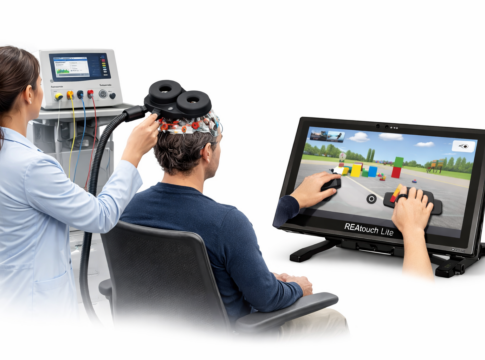
Améliorer la récupération motrice du bras après un AVC
Stimuler les réseaux cérébraux pour la récupération
INSPIRE utilise une technique de stimulation cérébrale non invasive pour activer les zones clés du cerveau impliquées...

Restaurer le mouvement après une paralysie
Stimulation électrique de la moëlle épinière
Un réseau d’électrodes implantables, connecté à un stimulateur implanté, délivre des impulsions électriques aux différents nerfs spinaux.
Chaque...
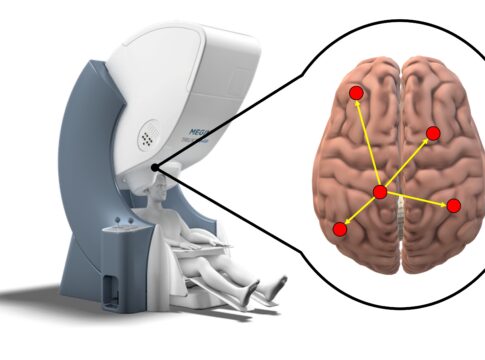
Comment les souvenirs évoluent-ils avec le temps ?
Une fenêtre sur le cerveau
La magnétoencéphalographie (MEG) nous permet d’enregistrer l’activité neuronale avec une grande précision spatiale et temporelle.
Nous utilisons cette technique...