


Grid cells in the entorhinal cortex (EC) encode an individual’s location in space, integrating both environmental and multisensory bodily cues. Notably, body-derived signals are also primary signals for the sense of self. While studies have demonstrated that continuous application of visuo-tactile bodily stimuli can induce perceptual shifts in self-location, it remains unexplored whether these illusory changes suffice to trigger grid cell–like representation (GCLR) within the EC, and how this compares to GCLR during conventional virtual navigation. To address this, we systematically induced illusory drifts in self-location toward controlled directions using visuo-tactile bodily stimulation, while maintaining the subjects’ visual viewpoint fixed (absent conventional virtual navigation). Subsequently, we evaluated the corresponding GCLR in the EC through functional MRI analysis. Our results reveal that illusory changes in perceived self-location (independent of changes in environmental navigation cues) can indeed evoke entorhinal GCLR, correlating in strength with the magnitude of perceived self-location, and characterized by similar grid orientation as during conventional virtual navigation in the same virtual room. These data demonstrate that the same grid-like representation is recruited when navigating based on environmental, mainly visual cues, or when experiencing illusory forward drifts in self-location, driven by perceptual multisensory bodily cues.
Publication scientifique
Changes in spatial self-consciousness elicit grid cell–like representation in the entorhinal cortex
Autres publications de la plateforme
Real-time Self-contact Retargeting of Avatars down to Finger Level
DELAHAYE, Mathias; Herbelin, Bruno; Boulic, Ronan
ICAT-EGVE 2023 - International Conference on Artificial Reality and Telexistence and Eurographics Symposium on Virtual Environments
Extrastriate activity reflects sensorimotor-induced bias in estimating number of visual humans
Albert, Louis; Herbelin, Bruno; Bernasconi, Fosco; Blanke, Olaf
Cerebral Cortex
An embodied body morphology task for investigating self-avatar proportions perception in...
Boban, Loën; Boulic, Ronan; Herbelin, Bruno
IEEE Transactions on Visualization and Computer Graphics
Impact of immersive virtual reality compared to a digital static approach...
Franco, Julie; Glize, Bertrand; Laganaro, Marina
Neuropsychologia
Noninvasive modulation of the hippocampal-entorhinal complex during spatial navigation in humans
Beanato, Elena; Moon, Hyuk-June; Windel, Fabienne; Vassiliadis, Pierre; Wessel, Maximillian J.; Popa, Traian; Pauline, Menoud; Neufeld, Esra; De Falco, Emanuela; Gauthier, Baptiste; Steiner, Melanie; Blanke, Olaf; Hummel, Friedhelm C.
Science Advances
Who says you are so sick? An investigation on individual susceptibility...
Tian, Nana; Boulic, Ronan
IEEE Transactions on Visualization and Computer Graphics
Journal de publication
Proceedings of the National Academy of Sciences
Auteurs:
Moon, Hyuk-June; Albert, Louis; De Falco, Emanuela; Tasu, Corentin; Gauthier, Baptiste; Park, Hyeong-Dong; Blanke, Olaf
Date de publication:
Plateforme:
Études récentes de la plateforme
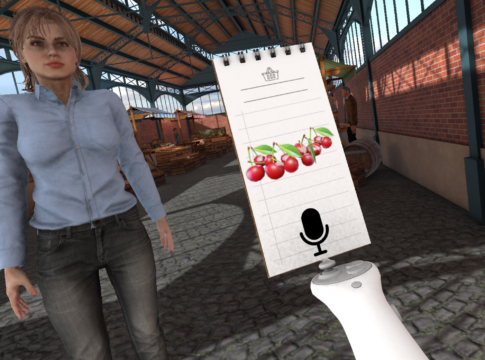
La réalité virtuelle pour combattre les troubles du langage
Evaluation linguistique dans des contextes communicatifs
Certains patients signalent un écart entre leurs performances dans le milieu médical et dans leur vie quotidienne.
Les...
Soulager l’anxiété des adolescents
Jeux vidéo pour soulager l’anxiété
Les jeux vidéo dédiés à la santé mentale sont devenus un outil de choix pour accompagner les adolescents, en...