

Abstract A spinal cord injury interrupts pathways from the brain and brainstem that project to the lumbar spinal cord, leading to paralysis. Here we show that spatiotemporal epidural electrical stimulation (EES) of the lumbar spinal cord 1–3 applied during neurorehabilitation 4,5 (EES REHAB ) restored walking in nine individuals with chronic spinal cord injury. This recovery involved a reduction in neuronal activity in the lumbar spinal cord of humans during walking. We hypothesized that this unexpected reduction reflects activity-dependent selection of specific neuronal subpopulations that become essential for a patient to walk after spinal cord injury. To identify these putative neurons, we modelled the technological and therapeutic features underlying EES REHAB in mice. We applied single-nucleus RNA sequencing 6–9 and spatial transcriptomics 10,11 to the spinal cords of these mice to chart a spatially resolved molecular atlas of recovery from paralysis. We then employed cell type 12,13 and spatial prioritization to identify the neurons involved in the recovery of walking. A single population of excitatory interneurons nested within intermediate laminae emerged. Although these neurons are not required for walking before spinal cord injury, we demonstrate that they are essential for the recovery of walking with EES following spinal cord injury. Augmenting the activity of these neurons phenocopied the recovery of walking enabled by EES REHAB , whereas ablating them prevented the recovery of walking that occurs spontaneously after moderate spinal cord injury. We thus identified a recovery-organizing neuronal subpopulation that is necessary and sufficient to regain walking after paralysis. Moreover, our methodology establishes a framework for using molecular cartography to identify the neurons that produce complex behaviours.
Publication scientifique
The neurons that restore walking after paralysis
Autres publications de la plateforme
Hypothalamic deep brain stimulation augments walking after spinal cord injury
Cho, Newton; Squair, Jordan W.; Aureli, Viviana; James, Nicholas D.; Bole-Feysot, Léa; Dewany, Inssia; Hankov, Nicolas; Baud, Laetitia; Leonhartsberger, Anna; Sveistyte, Kristina; Skinnider, Michael A.; Gautier, Matthieu; Laskaratos, Achilleas; Galan, Katia; Goubran, Maged; Ravier, Jimmy; Merlos, Frederic; Batti, Laura; Pages, Stéphane; Berard, Nadia; Intering, Nadine; Varescon, Camille; Watrin, Anne; Duguet, Léa; Carda, Stefano; Bartholdi, Kay A.; Hutson, Thomas H.; Kathe, Claudia; Hodara, Michael; Anderson, Mark A.; Draganski, Bogdan; Demesmaeker, Robin; Asboth, Leonie; Barraud, Quentin; Bloch, Jocelyne; Courtine, Grégoire
Nature Medicine
A neuronal architecture underlying autonomic dysreflexia
Soriano, Jan Elaine; Hudelle, Remi; Mahe, Lois; Gautier, Matthieu; Teo, Alan Yue Yang; Skinnider, Michael A.; Laskaratos, Achilleas; Ceto, Steven; Kathe, Claudia; Hutson, Thomas; Charbonneau, Rebecca; Girgis, Fady; Casha, Steve; Rimok, Julien; Tso, Marcus; Larkin-Kaiser, Kelly; Hankov, Nicolas; Gandhi, Aasta; Amir, Suje; Kang, Xiaoyang; Vyza, Yashwanth; Martin-Moraud, Eduardo; Lacour, Stephanie; Demesmaeker, Robin; Asboth, Leonie; Barraud, Quentin; Anderson, Mark A.; Bloch, Jocelyne; Squair, Jordan W.; Phillips, Aaron A.; Courtine, Gregoire
Nature
A soft, scalable and adaptable multi-contact cuff electrode for targeted peripheral...
Paggi, Valentina; Fallegger, Florian; Serex, Ludovic; Rizzo, Olivier; Galan, Katia; Giannotti, Alice; Furfaro, Ivan; Zinno, Ciro; Bernini, Fabio; Micera, Silvestro; Lacour, Stéphanie P
Bioelectronic Medicine
Epileptiform activity in brain organoids derived from patient with Glucose Transporter...
Müller, Yoann; Lengacher, Loïc; Friscourt, Fabien; Quairiaux, Charles; Stoppini, Luc; Magistretti, Pierre J; Lengacher, Sylvain; Finsterwald, Charles
Frontiers in Neuroscience
Hypothalamic deep brain stimulation augments walking after spinal cord injury.
Cho, Newton; Squair, Jordan W; Aureli, Viviana; James, Nicholas D; Bole-Feysot, Léa; Dewany, Inssia; Hankov, Nicolas; Baud, Laetitia; Leonhartsberger, Anna; Sveistyte, Kristina; Skinnider, Michael A; Gautier, Matthieu; Laskaratos, Achilleas; Galan, Katia; Goubran, Maged; Ravier, Jimmy; Merlos, Frederic; Batti, Laura; Pagès, Stéphane; Berard, Nadia; Intering, Nadine; Varescon, Camille; Watrin, Anne; Duguet, Léa; Carda, Stefano; Bartholdi, Kay A; Hutson, Thomas H; Kathe, Claudia; Hodara, Michael; Anderson, Mark A; Draganski, Bogdan; Demesmaeker, Robin; Asboth, Léonie; Barraud, Quentin; Bloch, Jocelyne; Courtine, Grégoire
Nature Medicine
Dual lineage origins contribute to neocortical astrocyte diversity
Zhou J, Vitali I, Roig-Puiggros S, Javed A, Cantando I, Puglisi M, Bezzi P, Jabaudon D, Mayer C, Bocchi R.
Journal de publication
Nature
Auteurs:
Kathe, Claudia; Skinnider, Michael A.; Hutson, Thomas H.; Regazzi, Nicola; Gautier, Matthieu; Demesmaeker, Robin; Komi, Salif; Ceto, Steven; James, Nicholas D.; Cho, Newton; Baud, Laetitia; Galan, Katia; Matson, Kaya J. E.; Rowald, Andreas; Kim, Kyungjin; Wang, Ruijia; Minassian, Karen; Prior, John O.; Asboth, Leonie; Barraud, Quentin; Lacour, Stéphanie P.; Levine, Ariel J.; Wagner, Fabien; Bloch, Jocelyne; Squair, Jordan W.; Courtine, Grégoire
Date de publication:
Plateforme:
Études récentes de la plateforme
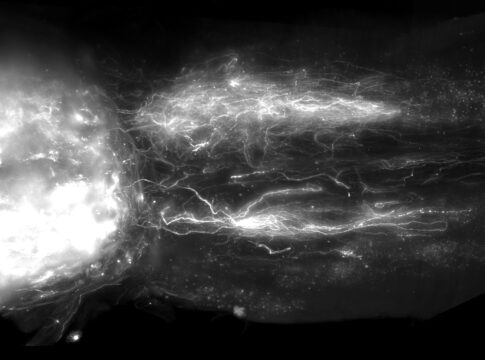
Réparer les lésions de la moelle épinière
Cibler les neurones qui rétablissent la marche
À l'aide de la transcriptomique unicellulaire et spécifique à la projection, les scientifiques ont découvert une population...

Restaurer le mouvement après une paralysie
Stimulation électrique de la moëlle épinière
Un réseau d’électrodes implantables, connecté à un stimulateur implanté, délivre des impulsions électriques aux différents nerfs spinaux.
Chaque...
Décoder les ondes de l’activité cérébrale
Comment nous avons identifié le mécanisme
Nous avons utilisé une technique appelée « optogénétique », qui utilise des impulsions lumineuses pour activer sélectivement le locus...