
Abstract Focal cortical dysplasia type II (FCDII), a major cause of pediatric drug-resistant focal epilepsy, results from brain somatic variants in mTOR pathway genes, including germline and somatic second-hit loss-of-function variants in the mTOR repressor DEPDC5. Here, we present a proof-of-concept model of DEPDC5 two-hit inactivation mosaicism using patient-derived human cortical organoids (hCOs). Mosaic hCOs displayed increased mTOR activity that was rescued by the mTOR inhibitor rapamycin. Mosaic hCOs also exhibited dysmorphic-like neurons and enhanced neuronal excitability, recapitulating key FCDII pathology hallmarks. Single-cell transcriptomics across three developmental stages revealed aberrant differentiation trajectories leading to premature upper-layer neuron generation, upregulated Notch and Wnt signaling pathways in neural progenitors, and altered expression of synaptic- and epilepsy-associated genes in excitatory neurons. In addition, we identified cell-autonomous alterations in metabolism and translation in mosaic DEPDC5 two-hit hCOs. This study provides novel insights into how DEPDC5 deficiency perturbs human corticogenesis, highlighting that mosaic biallelic inactivation of the gene is necessary for FCDII pathogenesis.
Publication scientifique
Mosaic human cortical organoids model mTOR-related focal cortical dysplasia through DEPDC5 deletion
Autres publications de la plateforme
Brain Mosaicism in Epileptogenic Cortical Malformations
Ribierre, Théo; Baulac, Stéphanie
Jasper's Basic Mechanisms of the Epilepsies
Du mosaïcisme cérébral aux crises d’épilepsie: Une nouvelle stratégie thérapeutique ciblée
Ribierre, Théo; Baulac, Stéphanie
médecine/sciences
Molecular programs guiding arealization of descending cortical pathways
Abe, Philipp; Lavalley, Adrien; Morassut, Ilaria; Santinha, Antonio J.; Roig-Puiggros, Sergi; Javed, Awais; Klingler, Esther; Baumann, Natalia; Prados, Julien; Platt, Randall J.; Jabaudon, Denis
Nature
Developmental emergence of first- and higher-order thalamic neuron molecular identities
Lo Giudice, Quentin; Wagener, Robin J.; Abe, Philipp; Frangeul, Laura; Jabaudon, Denis
Development
Targeting pathological cells with senolytic drugs reduces seizures in neurodevelopmental mTOR-related...
Ribierre, Théo; Bacq, Alexandre; Donneger, Florian; Doladilhe, Marion; Maletic, Marina; Roussel, Delphine; Le Roux, Isabelle; Chassoux, Francine; Devaux, Bertrand; Adle-Biassette, Homa; Ferrand-Sorbets, Sarah; Dorfmüller, Georg; Chipaux, Mathilde; Baldassari, Sara; Poncer, Jean-Christophe; Baulac, Stéphanie
Nature Neuroscience
Developmental emergence of cortical neurogliaform cell diversity
Gomez, Lucia; Cadilhac, Christelle; Prados, Julien; Mule, Nandkishor; Jabaudon, Denis; Dayer, Alexandre
Development
Journal de publication
Brain
Auteurs:
Maletic, Marina; Bizzotto, Sara; Ribierre, Théo; Guerdoud, Kenza; Raoux, Corentin; Doladilhe, Marion; Dalle, Carine; Picard, Fabienne; Baulac, Stéphanie
Date de publication:
Plateforme:
Études récentes de la plateforme
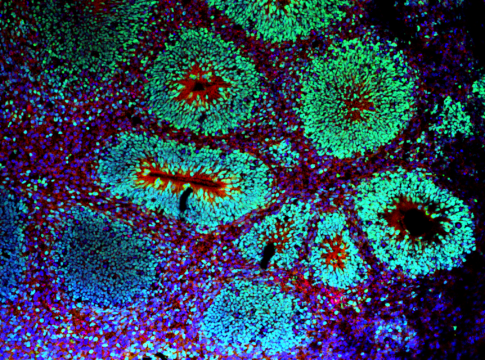
Reprogrammer des cellules humaines pour étudier les défauts du cerveau
Organoïdes cérébraux pour les troubles mentaux
Nous utilisons une approche appelée organoïdes cérébraux (« cerveau dans une boîte de Petri ») qui permet de...
Suivi de la dopamine dans la maladie de Parkinson
Détection de la dopamine grâce à des biosenseurs à base d’ADN
Une approche innovante utilise des brins d’ADN artificiellement conçus, appelés aptamères, qui capturent...
Suivre la trace des biomarqueurs sanguins de la maladie d’Alzheimer
Réinventer le diagnostic de la maladie d'Alzheimer
La maladie d’Alzheimer se développe des décennies avant l’apparition des symptômes.
Des recherches récentes suggèrent que le risque...