Abstract The flexion-relaxation phenomenon (FRP) is frequently absent among non-specific chronic low back pain (NSCLBP) patients. However, it is unknown whether this absence is intrinsic to their pathology or merely a consequence of reduced trunk flexion. Immersive virtual reality (IVR) can create a patient avatar whose range of motion can be modulated to differ from the real movement. The present study enrolled 15 NSCLBP patients and 15 asymptomatic participants with similar characteristics to disentangle the relationship between range of motion and the FRP in NSCLBP using IVR. Trunk kinematics and lumbar muscle electromyography were assessed. The IVR environment was combined with a motion capture system to create avatars that moved like each participant. The IVR display showed a closed room and a mirror reflecting the subject’s avatar with a target line to be reached by trunk flexion. The avatar’s trunk movements were modulated from reality, leading the participants to flex their trunk more than their voluntary maximum trunk flexion. Under IVR conditions, NSCLBP patients significantly increased their trunk flexion angle, which was coupled with a significant improvement in the FRP. The absence of the FRP among the NSCLBP population appeared to be primarily related to reduced trunk flexion.
Publication scientifique
Understanding the flexion-relaxation phenomenon in non-specific chronic low back pain patients throught immersive virtual reality feedback approach
Autres publications de la plateforme
A novel multidimensional dynamic difficulty adjustment algorithm: Use case in a...
Pasqualotto, Angela; Fanourakis, Marios; Menestrina, Zeno; Hummel, Friedhelm C.; Rancans, Elmars; Padberg, Frank; Bonne, Omer; Lotan, Amit; Bukowski, Esther; Lipskaya-Velikovsky, Lena; Nahum, Mor; Bavelier, Daphne
Psychological Methods
Extrastriate activity reflects sensorimotor-induced bias in estimating number of visual humans
Albert, Louis; Herbelin, Bruno; Bernasconi, Fosco; Blanke, Olaf
Cerebral Cortex
An embodied body morphology task for investigating self-avatar proportions perception in...
Boban, Loën; Boulic, Ronan; Herbelin, Bruno
IEEE Transactions on Visualization and Computer Graphics
Impact of immersive virtual reality compared to a digital static approach...
Franco, Julie; Glize, Bertrand; Laganaro, Marina
Neuropsychologia
Noninvasive modulation of the hippocampal-entorhinal complex during spatial navigation in humans
Beanato, Elena; Moon, Hyuk-June; Windel, Fabienne; Vassiliadis, Pierre; Wessel, Maximillian J.; Popa, Traian; Pauline, Menoud; Neufeld, Esra; De Falco, Emanuela; Gauthier, Baptiste; Steiner, Melanie; Blanke, Olaf; Hummel, Friedhelm C.
Science Advances
Embodiment in episodic memory through premotor-hippocampal coupling
Meyer, Nathalie Heidi; Gauthier, Baptiste; Stampacchia, Sara; Boscheron, Juliette; Babo-Rebelo, Mariana; Potheegadoo, Jevita; Herbelin, Bruno; Lance, Florian; Alvarez, Vincent; Franc, Elizabeth; Esposito, Fabienne; Morais Lacerda, Marilia; Blanke, Olaf
Communications Biology
Journal de publication
Scientific Reports
Auteurs:
Rose-Dulcina, Kevin; Dubessy, Margaux; Armand, Stéphane; Genevay, Stéphane
Date de publication:
Plateforme:
Études récentes de la plateforme
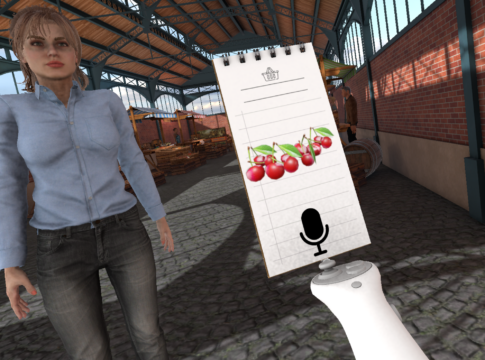
La réalité virtuelle pour combattre les troubles du langage
Evaluation linguistique dans des contextes communicatifs
Certains patients signalent un écart entre leurs performances dans le milieu médical et dans leur vie quotidienne.
Les...
Soulager l’anxiété des adolescents
Jeux vidéo pour soulager l’anxiété
Les jeux vidéo dédiés à la santé mentale sont devenus un outil de choix pour accompagner les adolescents, en...