

Abstract A spinal cord injury interrupts the communication between the brain and the region of the spinal cord that produces walking, leading to paralysis 1,2 . Here, we restored this communication with a digital bridge between the brain and spinal cord that enabled an individual with chronic tetraplegia to stand and walk naturally in community settings. This brain–spine interface (BSI) consists of fully implanted recording and stimulation systems that establish a direct link between cortical signals 3 and the analogue modulation of epidural electrical stimulation targeting the spinal cord regions involved in the production of walking 4–6 . A highly reliable BSI is calibrated within a few minutes. This reliability has remained stable over one year, including during independent use at home. The participant reports that the BSI enables natural control over the movements of his legs to stand, walk, climb stairs and even traverse complex terrains. Moreover, neurorehabilitation supported by the BSI improved neurological recovery. The participant regained the ability to walk with crutches overground even when the BSI was switched off. This digital bridge establishes a framework to restore natural control of movement after paralysis.
Publication scientifique
Walking naturally after spinal cord injury using a brain–spine interface
Autres publications de la plateforme
Hypothalamic deep brain stimulation augments walking after spinal cord injury
Cho, Newton; Squair, Jordan W.; Aureli, Viviana; James, Nicholas D.; Bole-Feysot, Léa; Dewany, Inssia; Hankov, Nicolas; Baud, Laetitia; Leonhartsberger, Anna; Sveistyte, Kristina; Skinnider, Michael A.; Gautier, Matthieu; Laskaratos, Achilleas; Galan, Katia; Goubran, Maged; Ravier, Jimmy; Merlos, Frederic; Batti, Laura; Pages, Stéphane; Berard, Nadia; Intering, Nadine; Varescon, Camille; Watrin, Anne; Duguet, Léa; Carda, Stefano; Bartholdi, Kay A.; Hutson, Thomas H.; Kathe, Claudia; Hodara, Michael; Anderson, Mark A.; Draganski, Bogdan; Demesmaeker, Robin; Asboth, Leonie; Barraud, Quentin; Bloch, Jocelyne; Courtine, Grégoire
Nature Medicine
A neuronal architecture underlying autonomic dysreflexia
Soriano, Jan Elaine; Hudelle, Remi; Mahe, Lois; Gautier, Matthieu; Teo, Alan Yue Yang; Skinnider, Michael A.; Laskaratos, Achilleas; Ceto, Steven; Kathe, Claudia; Hutson, Thomas; Charbonneau, Rebecca; Girgis, Fady; Casha, Steve; Rimok, Julien; Tso, Marcus; Larkin-Kaiser, Kelly; Hankov, Nicolas; Gandhi, Aasta; Amir, Suje; Kang, Xiaoyang; Vyza, Yashwanth; Martin-Moraud, Eduardo; Lacour, Stephanie; Demesmaeker, Robin; Asboth, Leonie; Barraud, Quentin; Anderson, Mark A.; Bloch, Jocelyne; Squair, Jordan W.; Phillips, Aaron A.; Courtine, Gregoire
Nature
Dual lineage origins contribute to neocortical astrocyte diversity
Zhou J, Vitali I, Roig-Puiggros S, Javed A, Cantando I, Puglisi M, Bezzi P, Jabaudon D, Mayer C, Bocchi R.
Urolithin A provides cardioprotection and mitochondrial quality enhancement preclinically and improves...
Liu S, Faitg J, Tissot C, Konstantopoulos D, Laws R, Bourdier G, Andreux PA, Davey T, Gallart-Ayala H, Ivanisevic J, Singh A, Rinsch C, Marcinek DJ, D’Amico D.
Regional differences in progenitor metabolism shape brain growth during development
Baumann N, Wagener RJ, Javed A, Conti E, Abe P, Lopes A, Sansevrino R, Lavalley A, Magrinelle, E, Szalai T, Fuciec Dm Ferreira C, Fievre S, Fouassier A, D’amico D, Harshnitz O, Jabaudon D
Journal de publication
Nature
Auteurs:
Lorach, Henri; Galvez, Andrea; Spagnolo, Valeria; Martel, Felix; Karakas, Serpil; Intering, Nadine; Vat, Molywan; Faivre, Olivier; Harte, Cathal; Komi, Salif; Ravier, Jimmy; Collin, Thibault; Coquoz, Laure; Sakr, Icare; Baaklini, Edeny; Hernandez-Charpak, Sergio Daniel; Dumont, Gregory; Buschman, Rik; Buse, Nicholas; Denison, Tim; Van Nes, Ilse; Asboth, Leonie; Watrin, Anne; Struber, Lucas; Sauter-Starace, Fabien; Langar, Lilia; Auboiroux, Vincent; Carda, Stefano; Chabardes, Stephan; Aksenova, Tetiana; Demesmaeker, Robin; Charvet, Guillaume; Bloch, Jocelyne; Courtine, Grégoire
Date de publication:
Plateforme:
Études récentes de la plateforme

Restaurer le mouvement après une paralysie
Stimulation électrique de la moëlle épinière
Un réseau d’électrodes implantables, connecté à un stimulateur implanté, délivre des impulsions électriques aux différents nerfs spinaux.
Chaque...
Décoder les ondes de l’activité cérébrale
Comment nous avons identifié le mécanisme
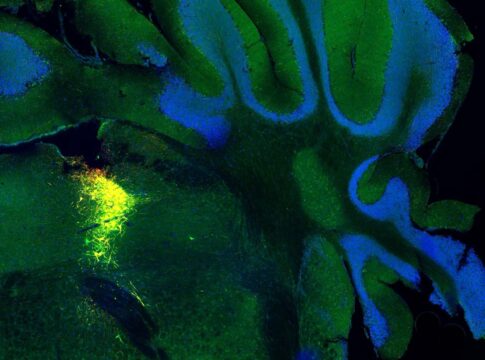
Nous avons utilisé une technique appelée « optogénétique », qui utilise des impulsions lumineuses pour activer sélectivement le locus...
Neuro-ingénieriePsychologie, neurosciences cellulaires et neurosciences cognitivesSciences affectives
Reconnecter le cerveau social
Rééquilibrer les neuromodulateurs
De nouvelles approches, y compris une stimulation cérébrale ciblée et des traitements à base de psychédéliques contrôlés avec soin, visent à...