


The human capacity to compute the likelihood that a decision is correct—known as metacognition—has proven difficult to study in isolation as it usually cooccurs with decision making. Here, we isolated postdecisional from decisional contributions to metacognition by analyzing neural correlates of confidence with multimodal imaging. Healthy volunteers reported their confidence in the accuracy of decisions they made or decisions they observed. We found better metacognitive performance for committed vs. observed decisions, indicating that committing to a decision may improve confidence. Relying on concurrent electroencephalography and hemodynamic recordings, we found a common correlate of confidence following committed and observed decisions in the inferior frontal gyrus and a dissociation in the anterior prefrontal cortex and anterior insula. We discuss these results in light of decisional and postdecisional accounts of confidence and propose a computational model of confidence in which metacognitive performance naturally improves when evidence accumulation is constrained upon committing a decision.
Publication scientifique
Disentangling the origins of confidence in speeded perceptual judgments through multimodal imaging
Autres publications de la plateforme
Linguistic pitch is hierarchically encoded in the right ventral stream
Oderbolz, Chantal; Orpella, Joan; Meyer, Martin
Communications Biology
EEG microstates: from methodological foundations to clinical translation
Michel, Christoph M.; Bréchet, Lucie
Trends in Neurosciences
Real-time reinforcement for human-machine interface control
Vassiliadis, Pierre; Pinheiro, Daniel Leal; Fleury, Lisa; Zenon, Alexandre; Esparza-Iaizzo, Martín; Ingster, Abigaïl; Micera, Silvestro; Shokur, Solaiman; Hummel, Friedhelm C.
Neuron
Characterising the Diffusion Functional Signature of Negative BOLD With Interleaved TMS...
De Riedmatten, Inès; Spencer, Arthur P. C.; Martuzzi, Roberto; Rochas, Vincent; Pérot, Jean‐Baptiste; Szczepankiewicz, Filip; Jelescu, Ileana O.
Human Brain Mapping
Visual perspective taking neural processing in forensic cases with high density...
Rochas, Vincent; Montandon, Marie-Louise; Rodriguez, Cristelle; Herrmann, François R.; Eytan, Ariel; Pegna, Alan J.; Michel, Christoph M.; Giannakopoulos, Panteleimon
Scientific Reports
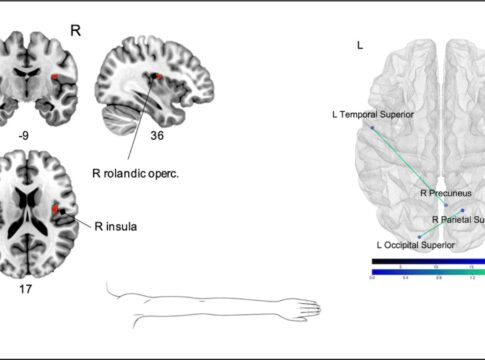
Causal disconnectomics of motion perception networks: insights from transcranial magnetic stimulation‐induced...
Raffin, Estelle; Salamanca‐Giron, Roberto F.; Huxlin, Krystel R.; Reynaud, Olivier; Mattera, Loan; Martuzzi, Roberto; Hummel, Friedhelm C.
The Journal of Physiology
Journal de publication
Proceedings of the National Academy of Sciences
Auteurs:
Pereira, Michael; Faivre, Nathan; Iturrate, Iñaki; Wirthlin, Marco; Serafini, Luana; Martin, Stéphanie; Desvachez, Arnaud; Blanke, Olaf; Van De Ville, Dimitri; Millán, José Del R.
Date de publication:
Plateforme:
Études récentes de la plateforme
Perte de conscience de soi
Eveiller la prise de conscience
Les troubles de la conscience de soi ne sont pas tous immédiatement perceptibles : certains restent masqués lors d'un...
Quand le cerveau s’éteint à l’IRM : un signal plus complexe...
Quand une diminution du signal reste difficile à interpréter
L’imagerie par résonance magnétique fonctionnelle (IRMf) permet de repérer les régions du cerveau qui réagissent...
La connaissance comme récompense
Comparaison de différents types de récompenses
Les participants prennent part à une tâche comprenant trois types de récompenses, de valeur élevée ou faible :
-...