

Abstract Objective. Sources of heterogeneity in non-invasive brain stimulation literature can be numerous, with underlying brain states and protocol differences at the top of the list. Yet, incoherent results from brain-state-dependent stimulation experiments suggest that there are further factors adding to the variance. Hypothesizing that different signal processing pipelines might be partly responsible for heterogeneity; we investigated their effects on brain-state forecasting approaches. Approach. A grid-search was used to determine the fastest and most-accurate combination of preprocessing parameters and phase-forecasting algorithms. The grid-search was applied on a synthetic dataset and validated on electroencephalographic (EEG) data from a healthy ( n = 18) and stroke ( n = 31) cohort. Main results. Differences in processing pipelines led to different results; the grid-search chosen pipelines significantly increased the accuracy of published forecasting methods. The accuracy achieved in healthy was comparably high in stroke patients. Significance. This systematic offline analysis highlights the importance of the specific EEG processing and forecasting pipelines used for online state-dependent setups where precision in phase prediction is critical. Moreover, successful results in the stroke cohort pave the way to test state-dependent interventional treatment approaches.
Publication scientifique
Optimization of phase prediction for brain-state dependent stimulation: a grid-search approach
Autres publications de la plateforme
Causal disconnectomics of motion perception networks: insights from transcranial magnetic stimulation‐induced...
Raffin, Estelle; Salamanca‐Giron, Roberto F.; Huxlin, Krystel R.; Reynaud, Olivier; Mattera, Loan; Martuzzi, Roberto; Hummel, Friedhelm C.
The Journal of Physiology
Boosting hemianopia recovery: the power of interareal cross-frequency brain stimulation
Raffin, Estelle; Bevilacqua, Michele; Windel, Fabienne; Menoud, Pauline; Salamanca-Giron, Roberto F; Feroldi, Sarah; Zandvliet, Sarah B; Ramdass, Nicola; Draaisma, Laurijn; Vuilleumier, Patrik; Guggisberg, Adrian G; Bonvin, Christophe; Fleury, Lisa; Huxlin, Krystel R; Beanato, Elena; Hummel, Friedhelm C
Brain
Return of the GEDAI: Unsupervised EEG Denoising based on Leadfield Filtering
Ros, Tomas; Férat, Victor; Huang, Yingqi; Colangelo, Cristina; Kia, Seyed Mostafa; Wolfers, Thomas; Vulliemoz, Serge; Michela, Abele
Multivariate deep phenotyping reveals behavioral correlates of non-restorative sleep in 22q11.2...
Reich, Natacha; Imparato, Andrea; Cataldi, Jacinthe; Thillainathan, Niveettha; Delavari, Farnaz; Schneider, Maude; Eliez, Stephan; Siclari, Francesca; Sandini, Corrado
Psychiatry Research
EEG microstate D as psychosis-specific correlate in adolescents and young adults...
Liebrand, Matthias; Katsarakis, Angelos; Josi, Johannes; Diezig, Sarah; Michel, Chantal; Schultze-Lutter, Frauke; Rochas, Vincent; Mancini, Valentina; Kaess, Michael; Hubl, Daniela; Koenig, Thomas; Kindler, Jochen
Schizophrenia Research
EEG correlates of egocentric and altercentric biases in forensic cases with...
Rochas, Vincent; Montandon, Marie-Louise; Rodriguez, Cristelle; Herrmann, François R.; Eytan, Ariel; Pegna, Alan J.; Michel, Christoph M.; Giannakopoulos, Panteleimon
Frontiers in Neuroscience
Journal de publication
Journal of Neural Engineering
Auteurs:
Bigoni, Claudia; Cadic-Melchior, Andéol; Morishita, Takuya; Hummel, Friedhelm C
Date de publication:
Plateforme:
Études récentes de la plateforme

Restaurer le mouvement après une paralysie
Stimulation électrique de la moëlle épinière
Un réseau d’électrodes implantables, connecté à un stimulateur implanté, délivre des impulsions électriques aux différents nerfs spinaux.
Chaque...
Comment les souvenirs évoluent-ils avec le temps ?
Une fenêtre sur le cerveau
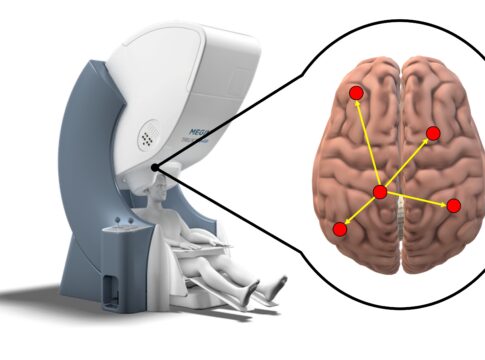
La magnétoencéphalographie (MEG) nous permet d’enregistrer l’activité neuronale avec une grande précision spatiale et temporelle.
Nous utilisons cette technique...
Stimulation cérébrale à domicile pour booster la cognition
Améliorer la cognition
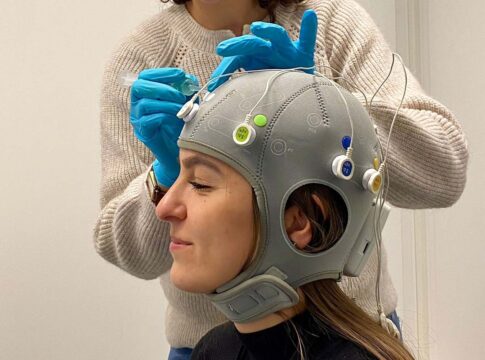
Explorer la stimulation cérébrale non invasive pour soutenir les fonctions exécutives
La stimulation transcrânienne par courant alternatif (tACS) utilise de faibles...