


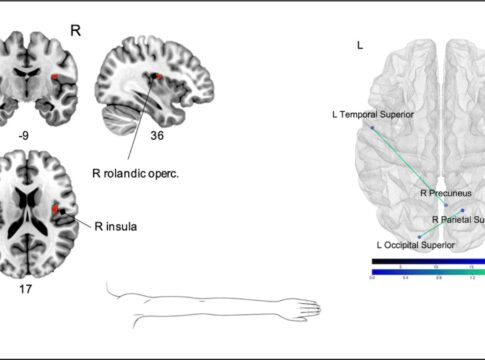
This high density EEG report dissects the neural processing in the visual perspective taking using four experimental comparisons (Arrow, Avatar and Self, Other). Early activation differences occurred between the Avatar and the Arrow condition in primary visual pathways concomitantly with alpha and beta phase locked responses predominant in the Avatar condition. In later time points, brain activation was stronger for the Avatar condition in paracentral lobule of frontal lobe. When taking the other’s perspective, there was an increased recruitment of generators in the occipital and temporal lobes and later on in mentalizing and salience networks bilaterally before spreading to right frontal lobe subdivisions. Microstate analysis further supported late recruitment of the medial frontal gyrus and precentral lobule in this condition. Other perspective for the Avatar only showed a strong beta response located first in left occipito-temporal and right parietal areas, and later on in frontal lobes. Our EEG data support distinct brain processes for the Avatar condition with an increased recruitment of brain generators that progresses from primary visual areas to the anterior brain. Taking the other’s perspective needs an early recruitment of neural processors in posterior areas involved in theory of mind with later involvement of additional frontal generators.
Publication scientifique
Mentalizing and self-other distinction in visual perspective taking: the analysis of temporal neural processing using high-density EEG
Autres publications de la plateforme
Linguistic pitch is hierarchically encoded in the right ventral stream
Oderbolz, Chantal; Orpella, Joan; Meyer, Martin
Communications Biology
EEG microstates: from methodological foundations to clinical translation
Michel, Christoph M.; Bréchet, Lucie
Trends in Neurosciences
Real-time reinforcement for human-machine interface control
Vassiliadis, Pierre; Pinheiro, Daniel Leal; Fleury, Lisa; Zenon, Alexandre; Esparza-Iaizzo, Martín; Ingster, Abigaïl; Micera, Silvestro; Shokur, Solaiman; Hummel, Friedhelm C.
Neuron
Characterising the Diffusion Functional Signature of Negative BOLD With Interleaved TMS...
De Riedmatten, Inès; Spencer, Arthur P. C.; Martuzzi, Roberto; Rochas, Vincent; Pérot, Jean‐Baptiste; Szczepankiewicz, Filip; Jelescu, Ileana O.
Human Brain Mapping
Visual perspective taking neural processing in forensic cases with high density...
Rochas, Vincent; Montandon, Marie-Louise; Rodriguez, Cristelle; Herrmann, François R.; Eytan, Ariel; Pegna, Alan J.; Michel, Christoph M.; Giannakopoulos, Panteleimon
Scientific Reports
Causal disconnectomics of motion perception networks: insights from transcranial magnetic stimulation‐induced...
Raffin, Estelle; Salamanca‐Giron, Roberto F.; Huxlin, Krystel R.; Reynaud, Olivier; Mattera, Loan; Martuzzi, Roberto; Hummel, Friedhelm C.
The Journal of Physiology
Journal de publication
Frontiers in Behavioral Neuroscience
Auteurs:
Rochas, Vincent; Montandon, Marie-Louise; Rodriguez, Cristelle; Herrmann, François R.; Eytan, Ariel; Pegna, Alan J.; Michel, Christoph M.; Giannakopoulos, Panteleimon
Date de publication:
Plateforme:
Études récentes de la plateforme
Perte de conscience de soi
Eveiller la prise de conscience
Les troubles de la conscience de soi ne sont pas tous immédiatement perceptibles : certains restent masqués lors d'un...
Quand le cerveau s’éteint à l’IRM : un signal plus complexe...
Quand une diminution du signal reste difficile à interpréter
L’imagerie par résonance magnétique fonctionnelle (IRMf) permet de repérer les régions du cerveau qui réagissent...
La connaissance comme récompense
Comparaison de différents types de récompenses
Les participants prennent part à une tâche comprenant trois types de récompenses, de valeur élevée ou faible :
-...